Coloured Pencils vs Markers for Adult Colouring
Zé · Published 21 October 2026
For adult colouring, coloured pencils are the easiest place to start: they forgive mistakes, build up in layers and work on ordinary printer paper. Felt tips (markers, in the US) give brighter, flatter colour much faster, but they streak if you rush and can bleed through thin paper. Many people end up using both: felt tips for big areas, pencils on top for shading.
Here is how to choose, which paper to print your colouring pages on, and how to get a clean finish with either.
Pencils or felt tips: the quick comparison
- Finish: soft, textured colour that you can shade with pencils; bright, smooth, even colour with felt tips.
- Mistakes: pencils can be lightened with an eraser and coloured over; a felt-tip line is there for good.
- Streaks: rare with pencils if you colour lightly; common with felt tips if you go back over ink that has already dried.
- Paper: pencils are happy on everyday 80 gsm paper; felt tips need something thicker, especially alcohol markers.
- Speed: a large area fills far faster with a felt tip.
- Blending: pencils blend layer over layer; among markers, only alcohol-based ones really blend into each other.
- Cost: a good set of pencils usually costs much less than a set of alcohol markers.
In short: pencils for beginners, for shading and for plain paper; felt tips for bold colour and big areas, on the right paper. Nothing stops you from using both on the same page.
Colouring pencils
Which ones?
A set of 24 to 36 colours is plenty to start with. Most coloured pencils are wax-based; oil-based pencils are a little firmer and hold a sharp point longer; watercolour pencils can be blended with a damp brush, but only on thick paper. Rather than counting colours, try a pencil in the shop or on a sample if you can: it should put down colour with light pressure, without scratching the paper.
Colouring without streaks
- Press lightly. Several light layers beat one heavy one, which flattens the grain of the paper and stops more colour going on.
- Colour in small circles or always in the same direction, not back-and-forth zigzags.
- Sharpen often. A fine point fills the little hollows of the paper and the corners of each shape.
- Go from light to dark. Lay the palest shade first, then add the shadows.
- Smooth it out at the end with a white or very pale pencil pressed a little harder, which blends the layers together.
Felt tips, markers and gel pens
Water-based or alcohol-based?
Water-based felt tips, the kind used at school, are cheap, have almost no smell and work well on slightly thicker paper. Alcohol markers give very smooth, even colour and blend into each other, but they soak through nearly every paper and have a strong smell: always put a spare sheet under the page. If you are not sure which you have, the packaging usually says.
Avoiding streaks with felt tips
- Work quickly, one area at a time, and fill the whole shape while the ink is still wet, without letting an edge dry.
- Use small, tight circles rather than parallel lines.
- Don't go back over dry ink, unless you want that area darker.
- Test in the margin first. Each felt tip behaves differently on each paper.
Gel pens
Gel pens are best for small areas, patterns and details: dots on a mug, stripes on a jumper, a sparkle in a cat's eye. A white gel pen on top of dark colours adds highlights that pencils can't. Let the ink dry before your hand passes over it, because gel smudges easily.
Which paper to print colouring pages on
- 80 gsm, ordinary printer paper: fine for coloured pencils.
- 100 to 120 gsm: nicer for water-based felt tips and gel pens, and sturdier for pencils pressed hard.
- 160 gsm and above: for heavy felt-tip work, if your printer accepts it. Even then, slip a spare sheet under the page for alcohol markers.
- Check your printer. The manual or the paper tray states the heaviest paper it takes.
- Print single-sided whenever you use felt tips.
In the US, paper is sold by pound weight: 20 lb bond is about 75 gsm, 24 lb about 90 gsm, 32 lb about 120 gsm, and 65 lb cover stock about 176 gsm.
One detail people often miss: on some inkjet prints, the black lines can run under a felt tip, especially an alcohol marker. Let the print dry fully and test a corner first. Laser toner usually holds better. If your colouring pages are US Letter size and you print on A4, choose “Fit to page” in the print window so nothing is cut off.
Combining pencils and felt tips
The simplest way to a good result: colour the large areas with felt tips, let them dry, then add shading and highlights with pencils on top. Finish with a gel pen for the details. The reverse works badly, because felt-tip ink slides over the wax of a pencil layer.
On pages where words are part of the design, such as quotes in outlined letters, try felt tips for the letters so they stand out, and pencils for the drawing around them.
A starter kit for beginners
- A set of 24 coloured pencils and a good sharpener.
- A soft white eraser.
- If you like bright colour: 12 to 24 water-based felt tips, plus a fine black pen to tidy outlines.
- Three or four gel pens, including a white one.
- A pack of 100 to 120 gsm paper, if your printer takes it, and a spare sheet to put underneath.
- A firm board to lean on and a lamp angled onto the page.
There is no need to buy 120 colours before you know whether you enjoy it. Add colours one by one later.
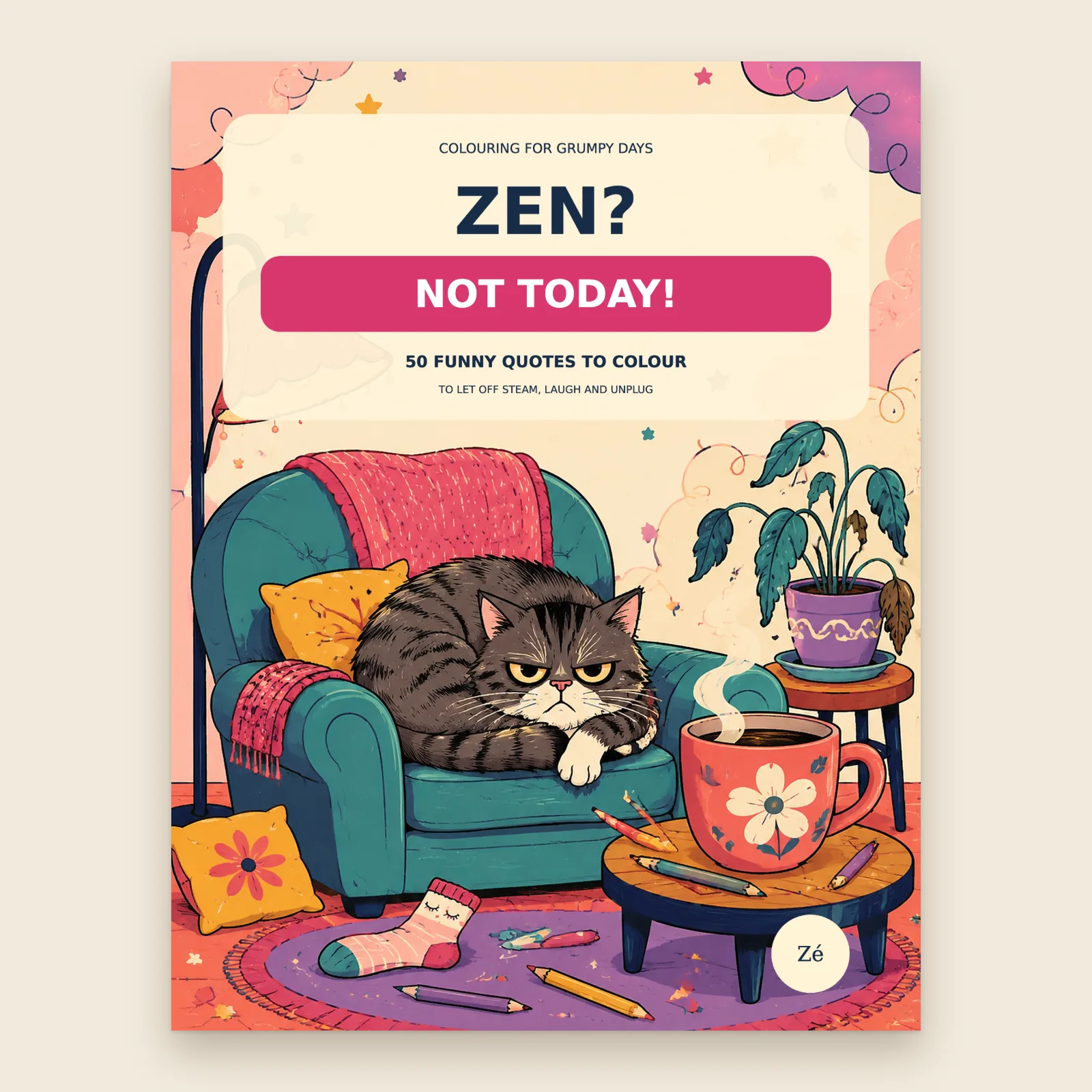
Our own colouring book, ZEN? NOT TODAY!, is made for this kind of kit: 50 funny everyday quotes (“My brain has too many tabs open”, “Normal service will resume after coffee”) in outlined letters, each with a cosy line drawing, and no swearing. It is a 52-page black-and-white PDF on US Letter pages, so you choose the paper to suit your pencils or felt tips and reprint a page that went wrong. It is in our adult colouring section.
50 funny quotes to colour
Frequently asked questions
Are coloured pencils or markers better for adult colouring books?
Pencils are better for beginners, for shading and for ordinary paper. Markers (felt tips) are better for bright, even colour and big areas, but they need thicker paper. Many people use markers for large areas and pencils on top.
What is the best paper for printing colouring pages?
80 gsm printer paper is fine for coloured pencils. For felt tips and gel pens, use 100 to 120 gsm (about 28 to 32 lb bond in the US), single-sided, if your printer accepts it.
Do gel pens bleed through paper?
They rarely soak through like alcohol markers, but heavy ink can show on the back of thin paper and smudges until it is dry. Use them for small areas and let each part dry before moving your hand across it.
Can I use alcohol markers on printer paper?
You can, but they will bleed through and may make inkjet lines run. Print single-sided on the thickest paper your printer takes, test a corner and always put a spare sheet underneath.