Things to Do With Kids Over the Christmas Holidays
Zé · Published 21 October 2026
The easiest way to fill the Christmas holidays with kids is to split the break into three parts, give each day one fixed point (a walk, a bake, a game) and keep one longer project going in the background. Below are 30 things to do with kids over the Christmas holidays, most of them free, sorted into outings, rainy-day ideas and projects that last several days.
The ideas suit children of roughly 5 to 12. Pick two or three for tomorrow rather than planning the whole fortnight at once.
Planning the holidays in three parts
In England and Wales, most schools break up in the week before Christmas and go back in the first week of January; in Scotland the dates are set by each council, so check your school's term calendar. In the US, winter break usually covers the same stretch, with dates that vary by district. Either way, the holiday has three quite different moods.
- From the end of term to Christmas Eve: the build-up. Children are excited and tired after a week of nativities and parties. Plan making things: cards, decorations, presents for grandparents.
- From Boxing Day to New Year's Eve: Twixmas. Nobody knows what day it is: time for long walks, new presents and one slow project per day.
- From New Year's Day to the first day back: the run-in. Bring back regular bedtimes, finish the projects and get uniforms ready a couple of days early.
Free outings when it's cold
In much of the UK it is dark by about 4pm in late December, so go out in the morning or straight after lunch. Layers, hats and a flask of something hot help.
- A Christmas lights walk. Head out after dark and vote for the best-lit house on your street.
- A winter woodland walk. Collect fallen pine cones, twigs and leaves for decorations. Only take what is already on the ground.
- Nature bingo. Write ten things to find before you leave: something round, something prickly, a feather, a frozen puddle.
- The Boxing Day walk. A family tradition in many British homes: the same route every year, with a photo at the same spot to compare.
- A trip to the library. Joining a public library is free. Choose a pile of winter books for Twixmas.
- Feed the birds. Hang pine cones rolled in vegetable fat and seeds, then keep a tally of visitors from the window over the following days.
- A frost hunt. On a cold, clear morning, look for frost patterns on cars, leaves and spiders' webs and sketch the best ones.
- Stargazing around the solstice. The longest night of the year falls around 21 December. Wrap up, move away from street lights and find the brightest star.
- A new route. Walk somewhere familiar a different way and spot five details you had never noticed.
- A kick-about or a bike ride. Parks are often quiet between Christmas and New Year.
Want one bigger day out as well? Book it early, because the popular dates go first: a pantomime (oh yes it is), an ice rink, a light trail or a visit to Father Christmas. In the US, a holiday show such as The Nutcracker plays the same part. One or two of those over the fortnight is plenty; the free ideas fill the other days.
Indoor ideas for rainy days
Wet days are part of a British Christmas. These need little more than paper, pencils and things already in the house. A treasure hunt round the house works too: we have 20 rhyming Christmas treasure hunt clues ready to hide.
- Build a story den. Chairs and blankets, lights off, a torch. Make up a story together, one sentence each.
- Christmas charades. Write seasonal words on slips of paper (snowman, reindeer, cracker) and act them out without speaking.
- Hum that tune. Hum a Christmas song without the words; whoever guesses first hums the next one.
- Living-room Olympics. Four short events: balance on one foot, throw rolled-up socks into a basket, tidy six objects against the clock, mime a sport. Clear the room first.
- Bake and decorate biscuits. Star and tree shapes, iced once they have cooled. An adult handles the oven.
- Paper snowflakes. Fold a square of paper into a triangle a few times, snip the edges, unfold and stick them on the windows.
- Thank-you letters, made fun. A drawing for younger children, a short letter for older ones. Two a day, not twelve at once.
- A mini escape room. An older child hides a small treat and sets three puzzles in a row: a jumbled word, a simple sum and a picture clue.
- A jigsaw on a tray. A 300 to 500-piece puzzle on a board that can be moved off the table at mealtimes.
- Card games. Snap, Old Maid, Go Fish or Rummy with one ordinary pack. Teach one new game during the holidays.
Projects that last several days
A project that picks up where it left off gives the slow days between Christmas and New Year a thread. Twenty to forty minutes a day is enough.
- A present workshop before Christmas. Over two or three afternoons: cards for grandparents, potato-print wrapping paper (an adult carves the shape), clove oranges tied with ribbon.
- Cress heads. Draw faces on empty eggshells, fill them with damp cotton wool and sprinkle cress seeds. Keep them on a windowsill and give them a haircut for a sandwich after about a week.
- A family quiz for New Year's Eve. Over the week, each person writes three questions about the others (favourite food, funniest holiday memory). Play it before the countdown.
- A holiday reading log. One book a day from the library pile, with a line on a chart: the title, the best bit and a mark out of ten.
- A cardboard town. Christmas packaging becomes houses, a shop, a park and a secret tunnel. Add one building a day and leave it set up in a corner.
- Round the world in the living room. One country per day: how to say hello, an animal, a drawing of a landmark and a mini-challenge. Non-fiction books from the library help check the facts.
- A holiday newspaper. One page a day: the weather, an interview with a relative, a review of a new present, a drawing for the front page.
- A New Year's Eve show. Rehearse a sketch, a song or a magic trick over the week, make tickets and perform before the countdown.
- A time capsule. On New Year's Eve, gather a letter to your future self, a drawing and a list of current favourites, seal the box and write next year's opening date on the lid.
- Half a day unplugged. Plan it together: a walk, a creative challenge, a meal cooked as a family and a quiet hour of reading or a game. Adults' phones stay in a drawer too.
Keeping a loose routine and agreeing on screen time
Most families relax the rules over Christmas. What causes arguments is usually not the screens themselves but rules that change from one hour to the next. A few things that keep the peace:
- Agree the rule before the holidays start, with the children, and write it on the fridge sheet. For example: screens after lunch, once everyone has been outside.
- Give screens a slot, not a limit you have to police. “Screen time is 4 to 5pm” is easier to stick to than counting minutes.
- Make films a family event. One Christmas film on the sofa with popcorn is a different thing from everyone on a separate device.
- Allow exceptions in advance. Christmas Day or a long car journey can have their own rules. Say so the day before.
- Have the next idea ready. The hardest moment is when the screen goes off: keep three things to do next on the list.
Ready-made ideas to print
Rather not think up something new every morning? Three printables do the planning for you. Our activity Advent calendar has 24 cards (crafts, cooking, games, outings and kindness), each with the materials, the time and an age guide. It is meant for 1 to 24 December, but the order is up to you, so families who start late simply use the cards through the holidays.
For children aged 7 to 12, 100 Screen-Free Challenges has one challenge per page, with the time, the number of players, the materials and a difficulty level from 1 to 3 stars. The cardboard town, the time capsule and round the world in the living room above are three of them. The challenge book sits in our screen-free activities section, and there are more indoor ideas in our list of screen-free activities for kids aged 7 to 12.
Driving to see family, or away for a few days? The travelling edition, 100 Screen-Free Holiday Challenges, has 100 more challenges for 7 to 12-year-olds, many made for journeys, the countryside and rainy days, and 57 of them need just paper and a pencil, or nothing at all. For the drive itself, see our car journey games for kids.
Printables for the holidays

100 screen-free challenges for ages 7-12
"I'm bored!" What if the answer fitted on one page?

100 screen-free holiday challenges for ages 7-12
"I'm bored!" on holiday? Here are 100 answers, one per page
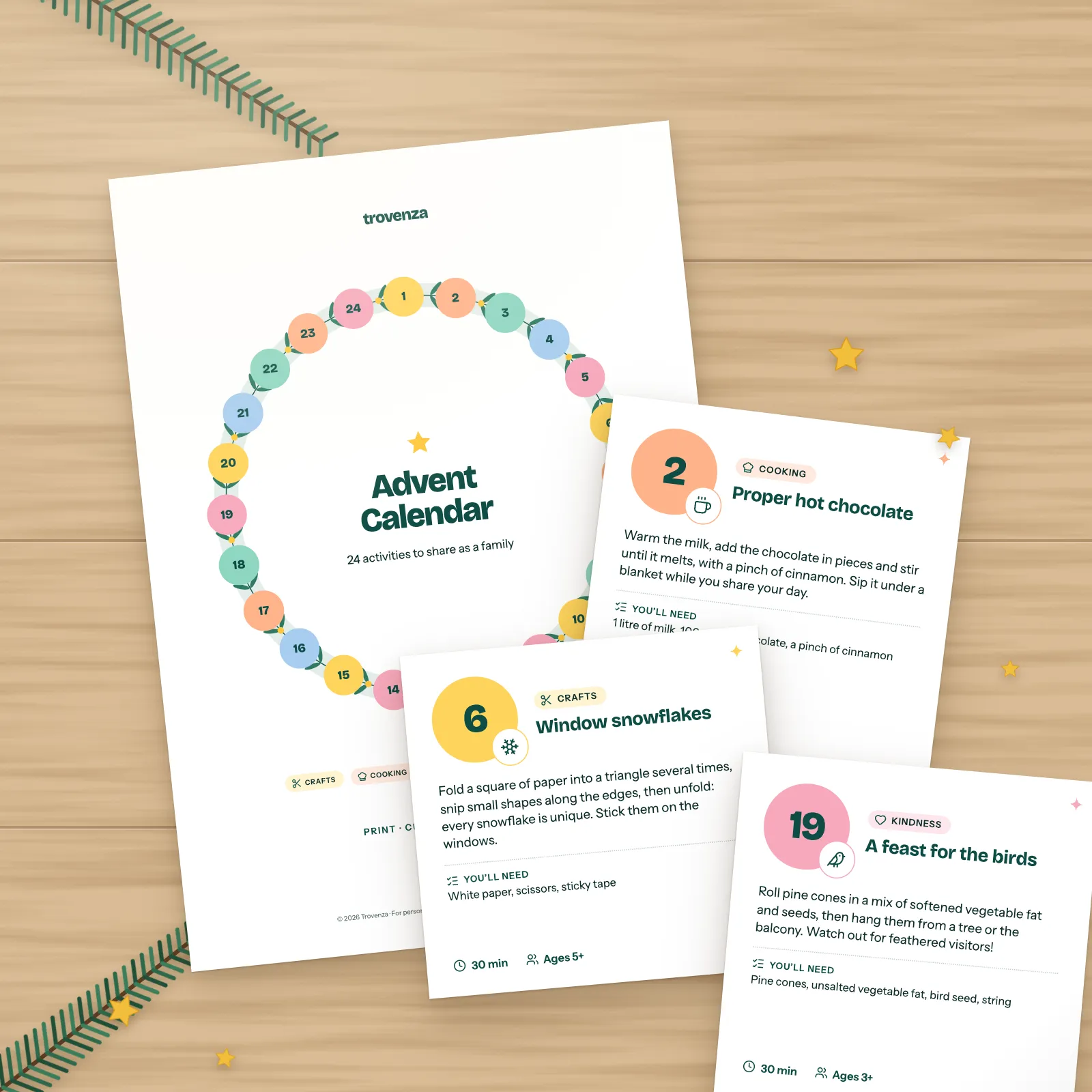
Printable Advent calendar: 24 family activities
What if Advent became family time again?
Frequently asked questions
What can I do with my kids over the Christmas holidays for free?
A Christmas lights walk, a woodland walk, the library, stargazing around 21 December, a story den, charades, paper snowflakes and a cardboard town made from Christmas packaging.
How do I keep kids busy between Christmas and New Year?
Give each day one anchor (a walk, a bake, a visit) and keep one project going over several days: a cardboard town, a holiday newspaper or a show to perform on New Year's Eve. The rest of the day can stay free.
When do schools break up for Christmas?
In England and Wales, usually in the week before Christmas, with the return in the first week of January. Scottish councils and US school districts set their own dates, so check your school's term calendar.
Should we relax screen time over the Christmas holidays?
That is a family choice. What helps most is deciding the rule before the holidays start, giving screens a fixed slot rather than a running limit, and agreeing exceptions such as Christmas Day in advance.