Personal Goals for Football Players: 25 Examples
Zé · Published 21 October 2026
A good personal goal for a football player is about something the player controls, and specific enough to check after the final whistle: “win the ball back three times in the first half”, not “play well”. It describes an action, not a result, and it fits the player's age and position.
Below: why “score a goal” makes a poor target, the difference between a match goal and a season goal, 25 examples sorted by age and position, how to track them in a journal, and one goal followed over three matches.
Why “score a goal” is not a good personal goal
Scoring depends on far too many things the player doesn't control: the position the coach picks, the minutes they get, the passes they receive, the opposition keeper. A defender may not get a single chance all match. And when the target is missed, the only lesson is “I failed”.
Turn the result into the actions that lead to it. A striker who wants goals can aim to “be in the box for every cross from our side” or “shoot every time I can see the goal inside the area”. Those depend on the player, can be counted, and still lead towards goals.
Match goal or season goal?
A season goal is what a player wants to improve over months: their weaker foot, their heading, talking more on the pitch. A match goal is one small action for today, chosen to move towards a season goal. One match goal at a time is plenty, and five season goals is a sensible maximum.
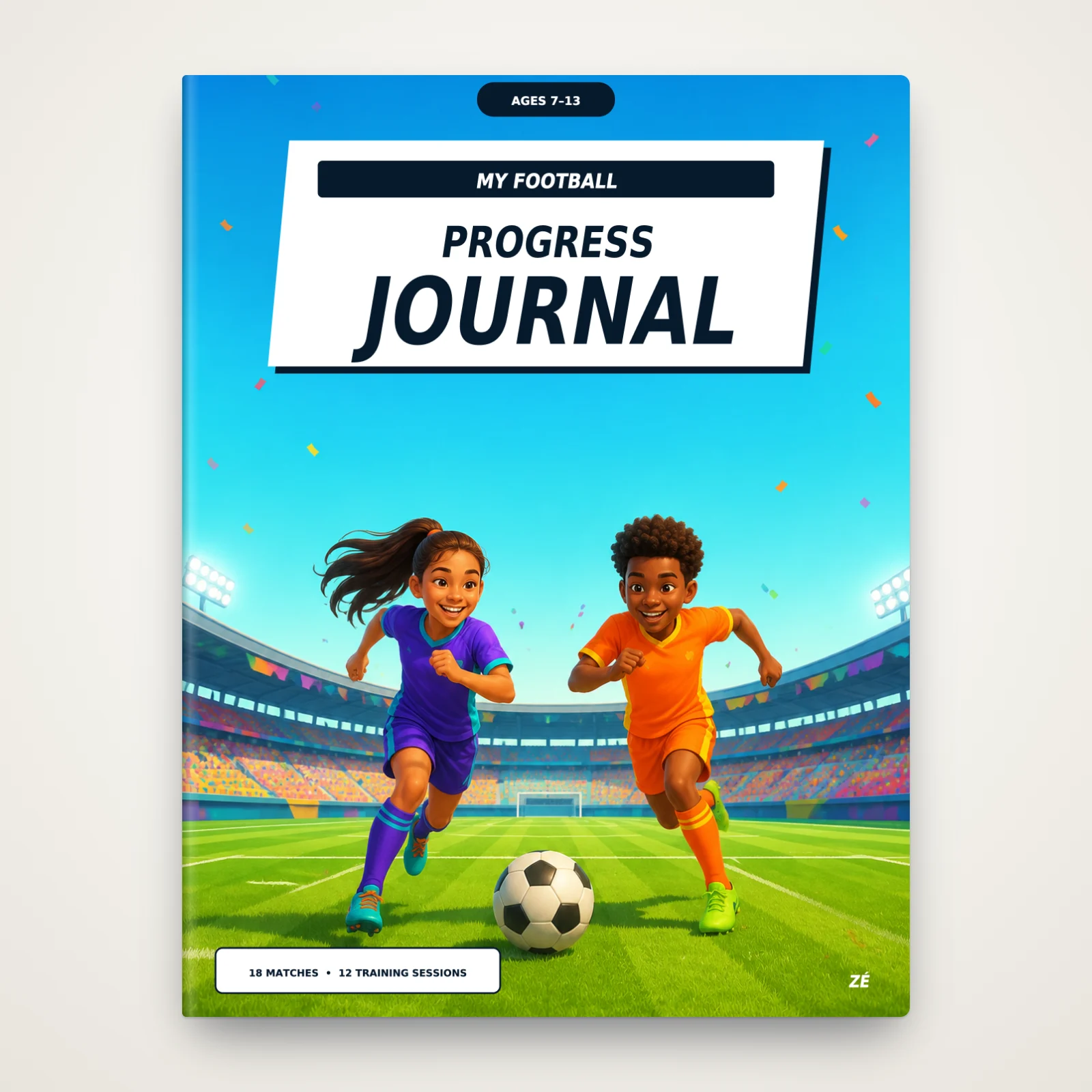
Our two football journals are built around this. In the kids' football journal for ages 7 to 13, the player writes 5 targets for the season, then fills in a “Before kick-off” page for each match: position, shirt number, the target for this match and a pitch to mark where they play. In the season journal for ages 13 to 17, each match starts with a game plan (planned position, tactical job and a measurable personal target), and each season target comes with a line for how it will be measured. As that journal puts it, a good target is precise, measurable and mostly up to you.
25 personal goal examples
Copy them, change the numbers to suit the player, and keep the wording in their own words.
Ages 7 to 9
- Use my weaker foot at least five times in the game.
- Call a teammate's name before I pass to them.
- Run back to our half every time we lose the ball.
- Have a go in goal for one game and get my body behind the ball.
- Try the turn we learnt at training at least once.
- Shake hands with every player on the other team at the end.
Ages 10 to 13
- Look over my shoulder before I receive the ball, at least five times.
- Make three forward passes that reach a teammate.
- Win the ball back within five seconds of losing it, three times.
- Shoot with my weaker foot at least once.
- Talk to my teammates: “Time!” or “Man on!” at least five times.
- Take our restarts quickly when it's our ball.
- Defend on my feet: no sliding in for the whole game.
Ages 14 to 17
- Win at least half of my duels in the air.
- Find a teammate with my first pass after winning the ball, four times out of five.
- Make three runs in behind the defence in each half.
- After a mistake: no gestures, straight back into position.
- Do my own pre-match routine before the team warm-up.
- Speak to the referee only through my captain.
By position
- Goalkeeper: shout “Keeper!” loudly every time I come for the ball.
- Goalkeeper: find a teammate with at least 8 of my 10 throws or rolls.
- Defender: keep the striker in front of me and stay on my feet until I can win the ball.
- Midfielder: receive on the half-turn, facing forward, at least five times.
- Winger or forward: take on my full-back 1v1 at least three times, and press their first pass when they have the ball.
- Striker: be in the box for every cross from our side.
How to track them
- Before the match, write the goal in one sentence, with the number that will show it was done.
- After the match, answer honestly: yes, partly or not yet, with the count if there is one. Add one thing that went well and one thing to work on.
- Rate it. The 13-17 journal has ratings from 1 to 10 after every match, for technique, tactical impact, physical effort, mental focus and overall; the 7-13 journal uses simple scales for enjoyment, effort and team spirit.
- Look back. Both journals rate skills at the start of the season and again at the end: 8 skills in the 7-13 journal, technical, tactical, physical and mental ones in the 13-17 journal.
- Re-read every month to see what is really changing, and keep or swap the goal.
Parents can help with one small habit: on the way home, ask “How did your target go?” before “Did you win?”.
Example: one goal followed over three matches
Imagine a 12-year-old central midfielder whose coach keeps saying “Check your shoulder!”. Season target: always know what's behind me before I get the ball. Match goal: look over my shoulder before receiving, at least five times.
- Match 1: counted twice. Forgot when the ball was coming quickly. Coach's tip, written in the journal: look while the ball is travelling to the full-back, not when it's coming to you.
- Match 2: five times. Turned with the ball twice when there was space behind. Target met: keep it one more week.
- Match 3: it starts to happen without thinking. New match goal: after turning, play forward within two touches.
Nothing magic: the journal simply makes the habit visible, match after match, and shows when it's time for the next goal.
Common mistakes
- Too many goals at once. Five targets for one match means none gets done.
- Goals about other people: “the coach starts me”, “we win the league”.
- Outcome-only goals: goals scored, man of the match, clean sheets, with no action behind them.
- Goals you can't check: “be better”, “try hard”.
- A new goal every week, before the last one had a chance.
- The parent's goal, not the player's. Help with the wording, but let them choose.
Two journals to write it all down
The football journal for kids aged 7 to 13 has 100 pages for 18 matches and 12 training sessions, with the “Before kick-off” page for every match. The football season journal for ages 13 to 17 has 120 pages for 25 matches and 15 training sessions, with stats, ratings and a coach's review at the end. Both print at home, for boys and girls in any position: see all our player journals.
A journal for every age

Frequently asked questions
What is a SMART goal in football?
A goal that is Specific, Measurable, Achievable, Relevant and Time-bound. “Get better at passing” isn't one; “make three forward passes that reach a teammate in Saturday's match” is.
How many personal goals should a player have at once?
One for each match, and no more than five for the season. Both our journals leave room for exactly 5 season targets.
Should parents set the goals?
Parents can help put a goal into words, especially at 7 or 8, but the player should choose it. A target they picked themselves is one they'll remember on the pitch.
What's the difference between team goals and personal goals?
Team goals, such as keeping a clean sheet or scoring from a corner, belong to the whole team and the coach. A personal goal is about one player's own actions, whatever the score.