Football Warm-Up Games for Kids: 8 Fun Games by Age
Zé · Published 21 October 2026
A good football warm-up for kids lasts 10 to 15 minutes and is a game, not a lap of the pitch: every child has a ball, the effort builds up gradually and the game suits the age group. A 5-year-old needs a story, an 8-year-old wants a challenge, and a 12-year-old can warm up with the passing pattern you'll use later in the session.
Below: 8 warm-up games by age group, from U6 to U13, and a 15-minute match-day routine. Coaches in the US can use them as soccer warm-up games for kids just as they are.
What a good warm-up looks like with children
With children, the warm-up is simply the first game of the session: it gets them moving, on the ball and listening, all at once. A simple way to build it is in three steps: a running or tag game, then dribbling, then changes of pace and direction.
- A ball each whenever you can. The warm-up is where children get the most touches of the session.
- Small groups, no queues. If more than three children are waiting for a turn, split the game into two areas.
- One instruction, in one sentence, then show it. The rest can wait for the first drinks break.
- A gentle start: easy dribbling for the first minute, then faster rounds.
- Short rounds of 60 to 90 seconds, with a breather and a sip of water in between.
U6-U7: 3 story games for 5 and 6-year-olds
All three games use a square of about 15 × 15 m marked with four cones, one ball per child and an adult who tells the story. They work with 6 to 12 children. Play rounds of about a minute and stop the game while they still want more.
1. Traffic lights (8 minutes)
Each child is a car and the ball is the engine: they drive around the square without bumping into anyone. The coach holds up a coloured bib. Green: drive. Amber: tiny touches. Red: stop the ball under the sole of the foot. Add a “Car wash!” call: everyone dribbles through a gate of two flat markers somewhere in the square, then carries on. Easier: green and red only. Harder: a police car in a bib tries to touch the balls, and any car that gets caught does five toe taps on top of its ball before driving off again.
2. Sharks and little fish (8 minutes)
Two children in bibs are sharks, with no ball. Everyone else is a little fish dribbling around the sea. A shark catches a fish by touching its ball with a foot. A caught fish holds its ball above its head and stands still like a starfish until another fish dribbles all the way round it. Change the sharks after every round so everyone has a go. Easier: one shark and a bigger sea. Harder: three sharks, or the fish may only use their weaker foot.
3. Bees back to the hive (8 minutes)
Spread four or five hoops or flat-marker squares around the area: these are the hives. The bees buzz around the garden with their ball. When the coach shouts “Rain!”, every bee dribbles into a hive and stops its ball inside. Then the coach takes one hive away, so the hives get busier each round. Nobody is ever out: bees simply share a hive. Easier: keep all the hives. Harder: the bees must reach a hive the coach names (“the blue one!”).
U8-U9: 3 games to get heads up
At 7 and 8, children love a challenge and a count. Use a 20 × 20 m square and one ball per child; these games suit 8 to 16 players.
4. Pirates (10 minutes)
Two or three pirates without a ball try to kick the other players' balls out of the square. A player who loses their ball fetches it, does five sole taps on the line and comes straight back in, so nobody waits on the side. Change the pirates every 90 seconds. Coaching point: keep the ball close and your body between the ball and the pirate. Harder: a player who wins a ball keeps it and the player who lost it becomes a pirate.
5. Gates (10 minutes)
Set out 8 to 10 gates of two flat markers, about 1.5 m wide, all over the square. Players dribble through as many different gates as they can in 60 seconds, counting out loud, and never through the same gate twice in a row. Round two: beat your own score. Round three: in pairs, pass to your partner through a gate, then both run to a new one. Looking for the next free gate is what lifts their heads.
6. Call the number (10 minutes)
Everyone dribbles freely. The coach calls a number and players do the action that goes with it: 1 = stop the ball with the sole, 2 = turn and go the other way, 3 = dribble to touch a corner cone, 4 = find a partner and swap balls. Start with two numbers and add one every round. It is a listening game as much as a dribbling one.
U10-U13: 2 warm-ups that lead into the session
From about 10, the warm-up can rehearse the main theme of the session. Start with a minute of easy jogging and passing in pairs, then move on to one of these.
7. 4v1 rondo (10 to 12 minutes)
In a 10 × 10 m square, four players keep the ball away from one defender in the middle. The defender swaps with the player who gave the ball away, or comes out after 60 seconds anyway. Count the passes: 10 in a row scores a point. Coaching points: the players either side of the ball move to offer a pass, and the first touch sets up the next pass. Easier: a 12 × 12 m square and unlimited touches. Harder: two touches maximum, or 5v2 for 12 and 13-year-olds. Use it before a session on keeping the ball.
8. Passing square (10 minutes)
Groups of 5 or 6 players around a 12 × 12 m square, one or two at each cone and one ball. Pass to the next cone and follow your pass. After two minutes, change direction; after four, receive on the back foot so you are already facing the next cone; after six, add a second ball. Use it before a session on passing and receiving.
Before a match: a 15-minute routine
On match day the warm-up has two jobs: get the ball rolling and calm the nerves. Here is a simple order that works at most ages, in the spirit of the Match day page of our U7 to U13 workbook (a fun game with a ball, a few passes and shots, then the line-up announced calmly).
- 0 to 5 minutes: a fun game with a ball, such as Sharks and little fish or Pirates.
- 5 to 10 minutes: passes in pairs, then a few shots at the goalkeeper. The keeper first takes some easy throws and rolls to their hands.
- 10 to 13 minutes: a quick small-sided game, 3v3 or 4v4, on a third of the pitch.
- 13 to 15 minutes: a drink, then the line-up announced calmly so everyone knows when they play, and one simple instruction for the whole team.
For under-7s playing 3v3, keep it even shorter and more playful: a story game, then 2v2 on one of the small pitches while you wait for the first round.
Mistakes to avoid
- Long, static lines where each child touches the ball once a minute.
- Laps of the pitch without a ball. A game with a ball gets them just as warm.
- Too much talking. Five minutes of explanation and the warm-up is over before it starts.
- A warm-up unrelated to the session. If today is about passing, warm up with a passing game.
- Eliminations. A child who is out for the rest of the game is a child who is not warming up.
Printable warm-up games in our coaching workbooks
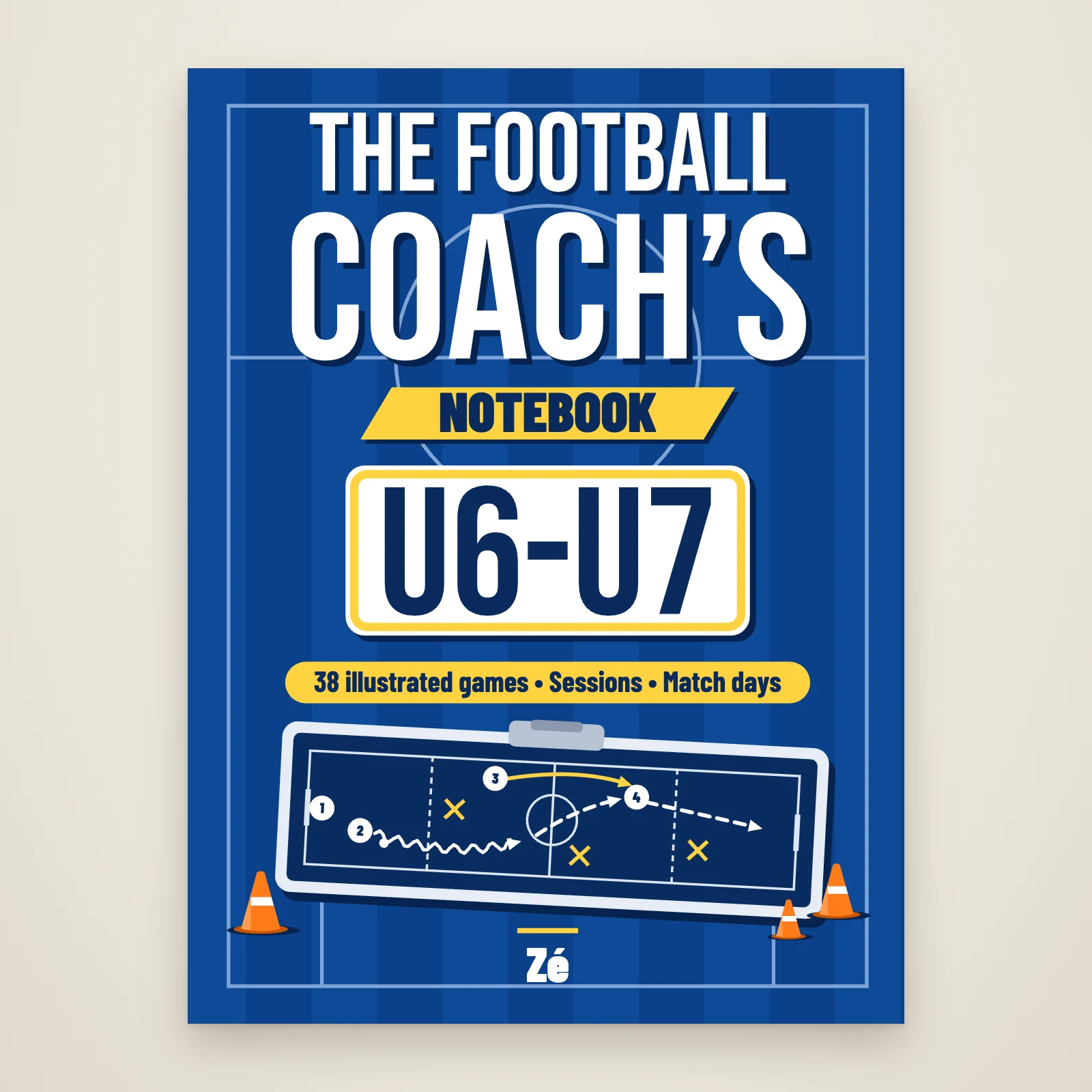
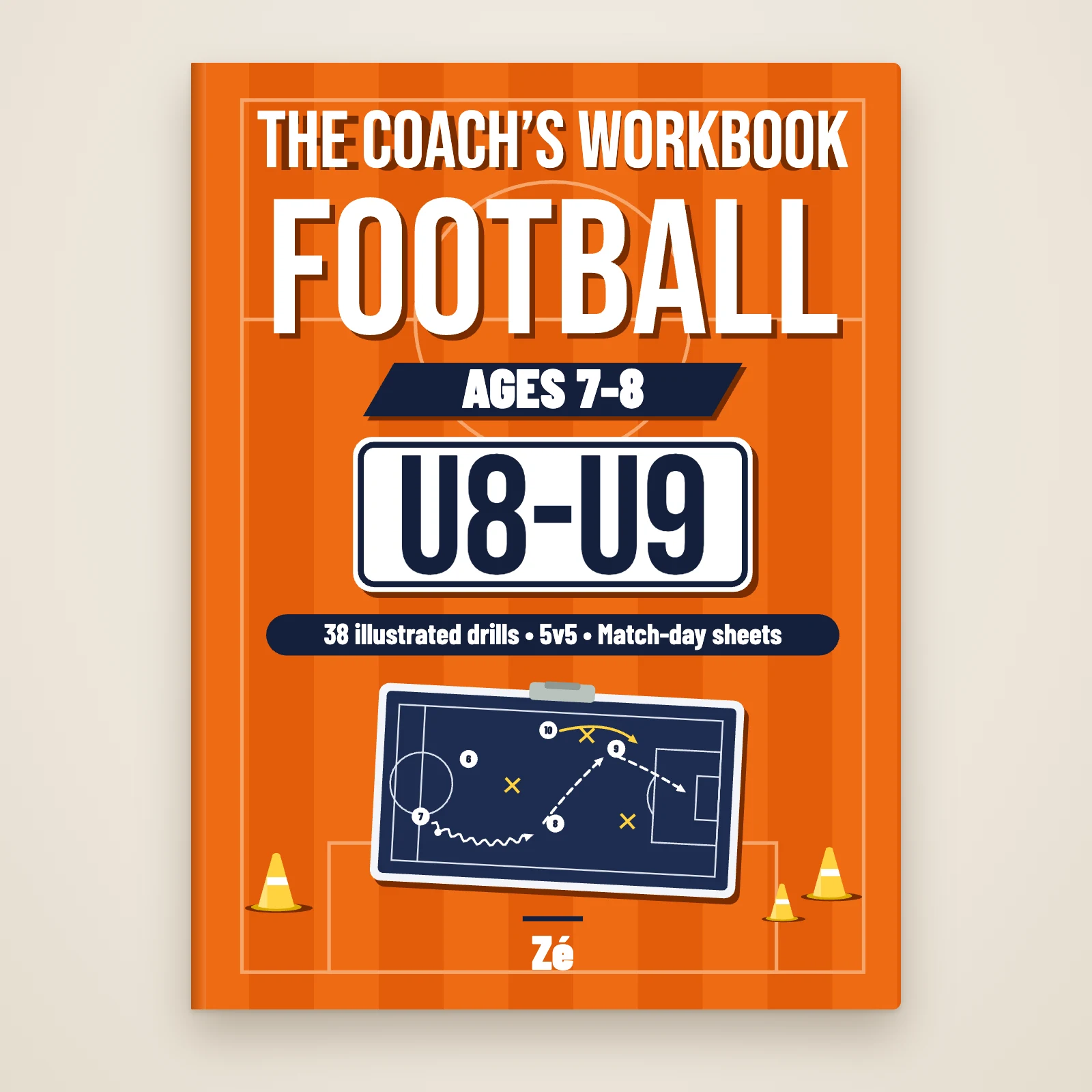
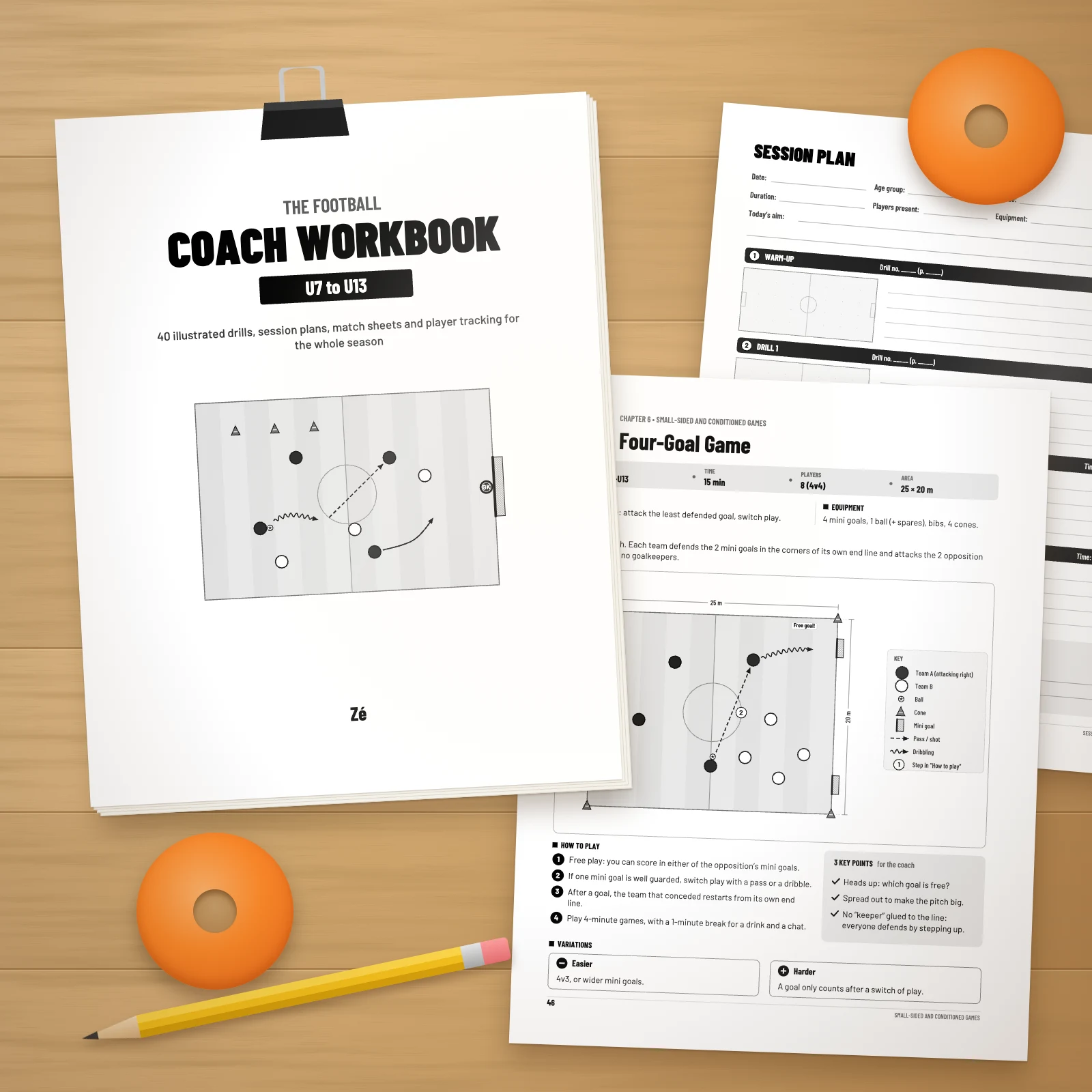
Each of our football coaching workbooks opens with a chapter of warm-up games, each on its own page with the time, the number of players, the area, the equipment, a diagram seen from above and an easier and a harder variation. The U6-U7 coach's notebook has 6 warm-up games told as stories, the U8-U9 workbook has 5 fun warm-ups among its 38 drills, and the U7 to U13 workbook has 6, marked by age group. They are printable PDFs in black and white.
Warm-ups, sessions and match days in one book
Frequently asked questions
How long should a kids' football warm-up be?
About 10 to 15 minutes, in short rounds. For 5 and 6-year-olds, one 8 to 10-minute game is usually plenty before the first game of the session.
Do kids need to stretch before football?
With young children, a game with the ball that starts gently and builds up does the job, so there is no need to line them up for a block of static stretches. Save the talking for drinks breaks, and if your club has its own warm-up routine, follow it.
Can I use the same warm-up every week?
Yes, and young children like the routine. Keep the same game but change one thing each week: the story, the size of the area, one extra rule or the foot they use.
What warm-up works before a 3v3 match day?
Something short and playful with a ball: a story game, then 2v2 on a small pitch. Under-7 match days are a series of short games, so the children will be playing again within minutes.