U9 Football Drills: 8 Fun Games for 5v5 (U8-U9)
Zé · Published 21 October 2026
The best U9 football drills are short games with a ball each, a goal or a line to aim at and almost no queuing, and they look like the 5v5 your players meet on match day. Here are 8 drills for 7 and 8-year-olds (U8s and U9s), two for each skill, with the area, numbers, timings and an easier and a harder version, plus a sample session and the 5v5 rules in brief.
They work for U8s just as well, and coaches in the US can use them as U9 soccer drills: only the match format may differ, so check your league.
5v5 at U8-U9 in brief
From the 2026-27 season, England Football's matchday format for U8s and U9s is 5v5, described as the maximum format for these age groups. The key points:
- Players: 5v5 including a goalkeeper, with rolling substitutions. Best practice is for every player to play at least 50% of each game.
- Pitch: 37 × 27 m recommended (also the maximum), 27 × 18 m minimum.
- Goals and ball: 12 × 6 ft goals, size 3 ball.
- Restarts: from the sideline, players pass or dribble the ball in.
- Retreat line: at goal kicks, the opponents drop back (usually to halfway) until the ball is played, so the keeper can play out.
- Other rules: no heading, no offside, a match official for every game, and games of up to 40 minutes.
Leagues add their own details (halves or quarters, festivals, trophy events), and your league's rules always come first. The drills below all build towards this game: dribbling out of tight spaces, passing along the ground, shooting at a real keeper and defending 1v1 on your feet.
A sample U9 session (about an hour)
- Arrival (5 min): balls out, a game of keepy-uppies while everyone turns up.
- Warm-up (10 min): a tag game with a ball, such as Pirates from our football warm-up games for kids.
- Drill 1 (12 to 15 min): Coast to coast (drill 1 below).
- Drill 2 (12 to 15 min): 1v1 to the line (drill 7).
- 5v5 game (15 to 20 min): the retreat-line game (drill 8).
- Review (5 min): “What did you learn? What did you enjoy?”, then tidy up together.
Pick one aim per session and drills that point the same way. Drinks break between activities, and change the drill as soon as attention drops: at 7 and 8, several short games beat one long drill.
Dribbling and running with the ball
1. Coast to coast (12 min)
Area: 25 × 20 m. Players: 8 to 14, a ball each, all on one end line. On “Go!”, players push the ball out in front with their laces and run with it to the far line, then stop it on the line with the sole. After three rounds, two defenders without a ball stand in the middle third and try to kick balls out. Coaching points: big touches into open space, small touches near a defender, head up between touches. Easier: one defender. Harder: players who lose their ball become defenders.
2. Gates and gatekeepers (10 min)
Area: 20 × 20 m with 8 gates of flat markers, 2 m wide. Players: 8 to 16, a ball each, plus two gatekeepers in bibs. Players dribble through as many gates as they can in 60 seconds and count them. A gatekeeper can step into any gate to close it, so players have to look up and find an open one. Swap gatekeepers each round. Easier: wider gates. Harder: a point only counts if you change direction straight after the gate.
Passing and receiving
3. Pass and follow triangles (12 min)
Area: triangles of cones 8 to 10 m apart. Players: groups of 3 or 4, one ball per group. Pass along the ground to the next cone and follow your pass. Receive with the foot furthest from the ball so your body is already open to the next cone. Count the passes in 60 seconds, then change direction. Easier: stop the ball before you pass. Harder: two touches maximum, then one touch for the confident groups.
4. End-zone game (12 min)
Area: 20 × 15 m with a 2 m end zone at each end. Players: 3v3 or 4v4, no keepers. A team scores when a player receives a pass inside the opponents' end zone and stops the ball there. Dribbling into the zone does not count: it has to be a pass. Children quickly learn to move into space and look forward. Easier: add a joker who plays for the team in possession. Harder: 3 passes before a team may score.
Shooting and finishing
5. Through the gate and shoot (12 min)
Area: a goal with a keeper, a gate of flat markers 12 m out and a line of flat markers at 8 m. Players: two lines of 3 or 4. The first player dribbles through the gate and must shoot before reaching the 8 m line; the next player in the other line goes as soon as the keeper is ready. Follow your shot for any rebound. Change keeper every 5 shots. Easier: shoot from a still ball. Harder: the coach calls “Left!” or “Right!” as the player comes through the gate, and that's the foot to shoot with.
6. Two-goal shooting battle (10 min)
Area: two goals 20 m apart, a halfway line of flat markers. Players: two teams of 3 or 4, each with a keeper. Players shoot from their own half at the other goal, and keepers save and roll the ball out to a teammate. Nobody crosses halfway. Lots of shots, lots of saves, and every child gets a spell in goal. Easier: move the goals closer. Harder: only first-time shots count double.
1v1s and playing 5v5
7. 1v1 to the line (12 min)
Area: channels of 15 × 10 m, one per pair or trio. The defender passes the ball to the attacker from the far line and runs out to defend. The attacker scores by stopping the ball on the defender's line; the defender scores by winning the ball and dribbling over the halfway point of the channel. Swap roles every turn. Coaching point for defenders: stay on your feet and show the attacker towards the side. Harder: the attacker has 6 seconds to score.
8. The retreat-line game (15 to 20 min)
Area: 30 × 20 m, two goals with keepers, a halfway line of flat markers. Players: 4 + a keeper on each side. Play normal 5v5, with one rule: at every goal kick, the opponents jog back behind the halfway line until the keeper's pass has been played, just as on match day. Give a bonus goal when a team scores within 4 passes of its keeper starting the move. Restarts from the sideline are a pass or a dribble. Easier: a joker for the team in possession. Harder: score only after every outfield player has touched the ball.
A skills challenge to track over the season
Seven and eight-year-olds love a personal best. Our U8-U9 workbook suggests an 8-level keepy-uppy challenge: level 1 is drop the ball, one touch with the stronger foot and catch it; the middle levels ask for 3 and then 5 touches in a row without a bounce; level 8 is 8 touches alternating right and left. A level is passed when a child has done it 3 times. Run a challenge for five minutes at the end of a session, write down the date each level is passed, and compare every child with themselves only: no scores, no tables.
Common mistakes at U9
- One ball for a line of eight children.
- Full-size pitches and goals in training, where the quickest child gets every touch.
- Fixed positions too early: “You're a defender, stay back.” Rotate everyone, keeper included.
- The same child in goal every week.
- Long explanations. If it takes more than 30 seconds, show it instead.
Drills and match-day sheets to print
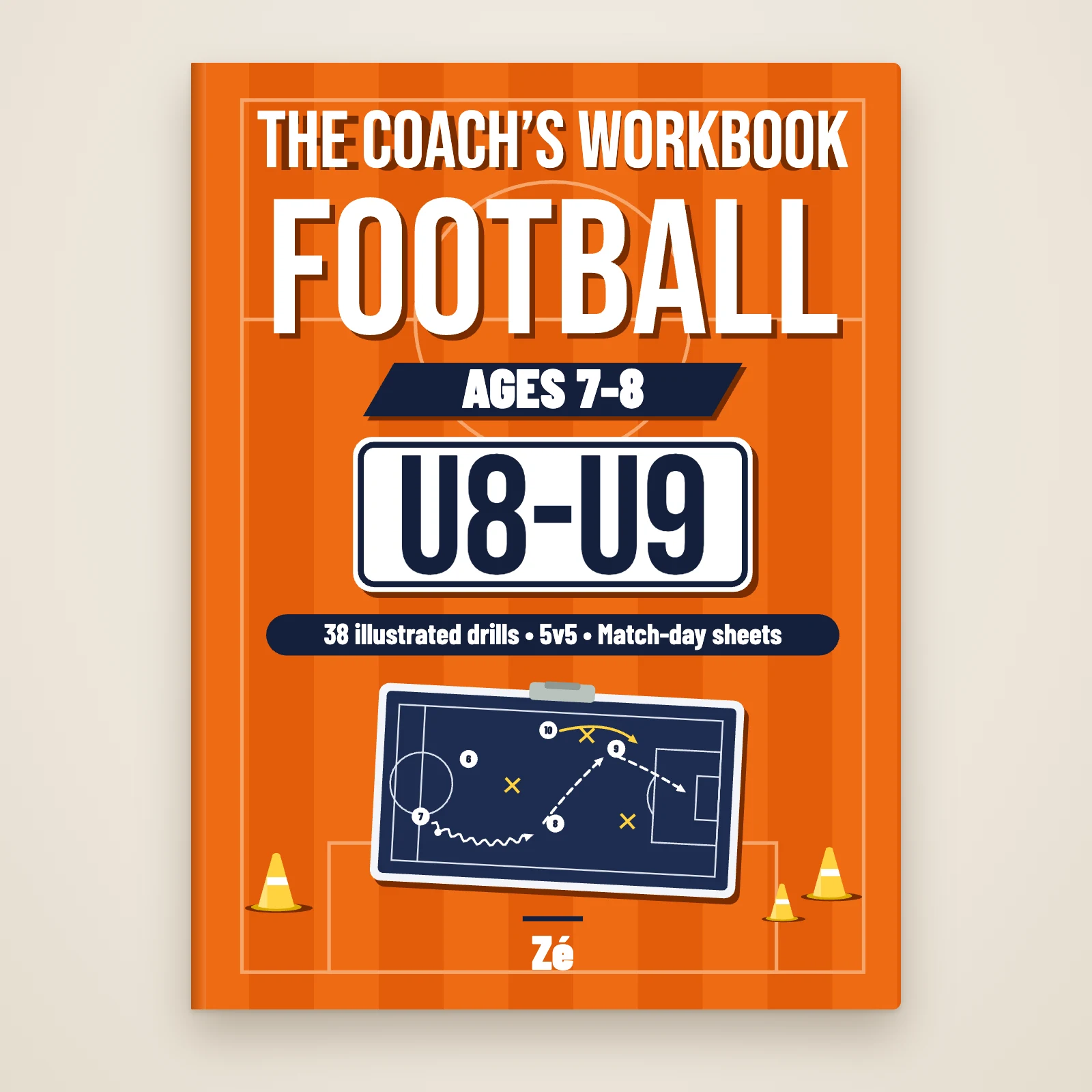
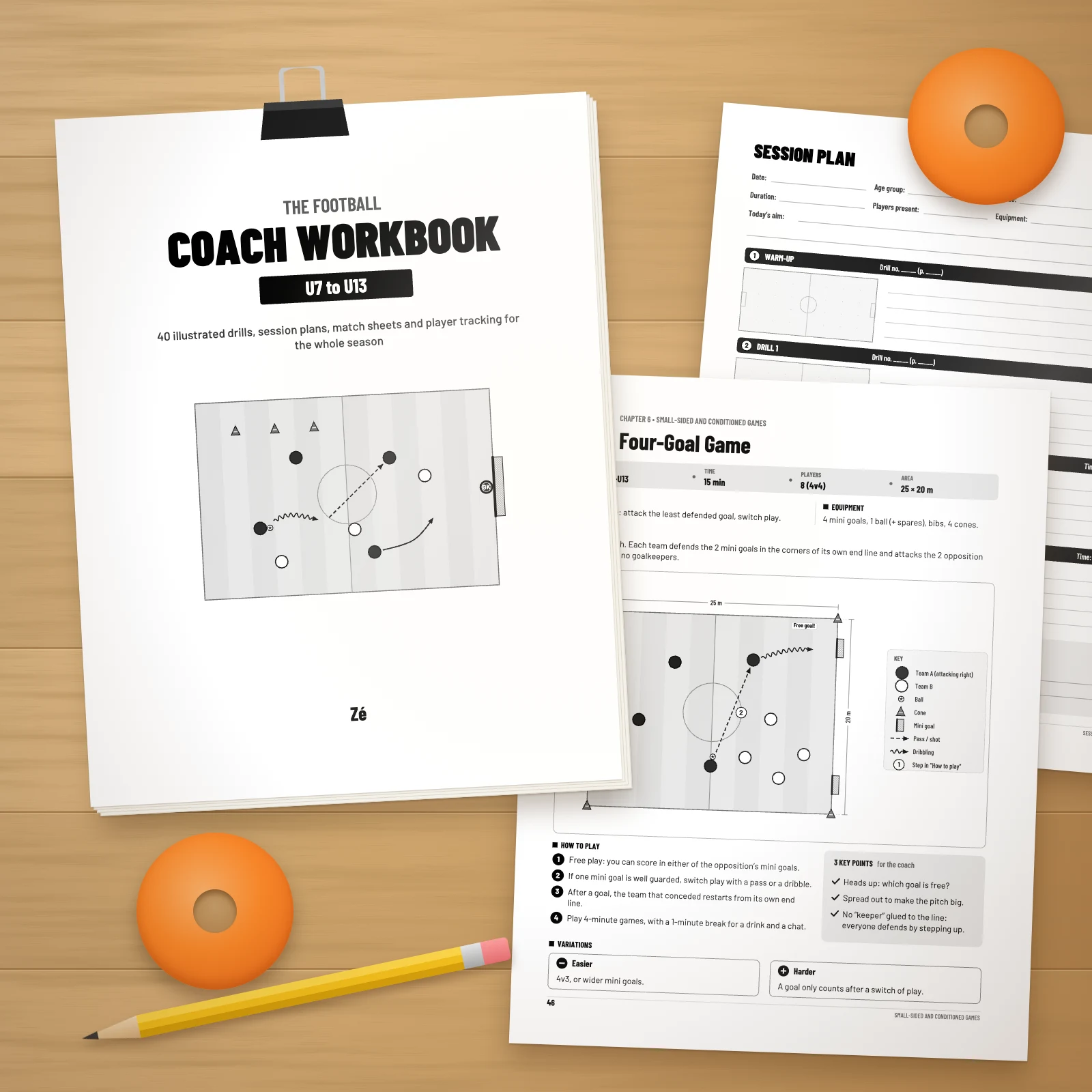
The U8-U9 football coaching workbook has 38 drills like these for 7 and 8-year-olds, each with a diagram seen from above, 24 session sheets, 16 match-day sheets that track every child's minutes and a page on 5v5 from England Football's guidance. If you also coach older players, the U7 to U13 workbook adds 40 drills marked by age group and 20 match sheets. Browse all our football coaching workbooks.
A season of U8-U9 sessions
Frequently asked questions
How long is a U9 football match?
Under England Football's 5v5 guidance, games last up to 40 minutes. Your league decides how they are split, for example into halves or quarters, and how many games are played on a match day.
What size pitch do U9s play on?
England Football recommends 37 × 27 m for 5v5, which is also the maximum, with a minimum of 27 × 18 m and 12 × 6 ft goals.
Should everyone go in goal?
It's good practice at this age to rotate the keeper from one game to the next, so every child has a go and nobody is stuck there all season.
How many drills should I do in one session?
Two, between a warm-up and a game. With 7 and 8-year-olds, two drills of 12 to 15 minutes and a 5v5 game of 15 to 20 minutes fill an hour well.