U7 Football Session Plan: 1 Hour, 6 Games, 3v3 Finish
Zé · Published 21 October 2026
A U7 football session lasts about an hour and follows the same thread every week: a welcome (5 minutes), a warm-up game (10), two short games on one theme (10 + 10), a mini-match (15) and a cool-down (5). Under-7s are in Year 2: they start the season aged 6 and turn 7 during it, so every game needs a ball for each child, a little story and a coach who stops it while they still love it.
Below: that outline in detail, the kit for 8 to 12 children, 6 games with their set-up and timings, how to finish with 3v3 like on match day, a plan for the season and what to do when it pours. It works just as well for U6s, and for coaches in the US looking for soccer practice plans for U7: check your league's match format.
The outline of a U7 session
- Welcome (5 min): hello to every child by their first name, shin pads and water bottles checked, the theme in one sentence: “Today our ball is a puppy, and we keep it on a short lead.”
- Warm-up game (10 min): a game with a ball each and no queue.
- Game 1 (10 min) and game 2 (10 min): two games on the same theme, such as keeping the ball close, aiming and scoring, beating a player or playing with a friend.
- Mini-match (15 min): 3v3 on small pitches, with mini goals.
- Cool-down (5 min): a circle, “What did you enjoy?”, a word for each child, then tidy up together.
The times are a guide: shorten a game when attention drops, lengthen the mini-match on a good day. Have a drinks break between games. One theme per session is plenty: the children meet it in every game and you know exactly what to watch for.
Equipment for 8 to 12 children
- A size 3 ball for every child, and a pump.
- 20 to 30 flat markers and 4 to 8 cones.
- Bibs in two colours.
- 2 to 4 mini goals or pop-up goals, weighted down; two cones per goal will do.
- A few hoops for target and “home” games.
- A first-aid kit, an ice pack, your phone and the parents' contact numbers.
Set everything out before the children arrive. A pitch that is ready means five more minutes of play and a much calmer start.
6 fun games for a U7 session
Each game starts in under a minute and works with 6 to 12 children. Tell the story first: at this age, “walk your puppy” means far more than “close control”.
1. Puppy on a lead (warm-up, 8 to 10 min)
Area: 15 × 15 m, a ball each. The ball is a puppy that must stay close. “Walkies!”: dribble anywhere. “Sit!”: stop the ball with the sole. “Fetch!”: leave the puppy, run round a cone and come back to it. “Bath time!”: dribble through a gate of two flat markers. Easier: only Walkies and Sit. Harder: “Tired puppy!” means weaker foot only.
2. Knock down the skittles (aim, 10 min)
Area: 12 × 8 m, a row of 8 to 10 cones across the middle, two teams on opposite end lines with a ball each. Children pass the ball from their line to knock cones over, fetch any ball that reaches them and go again. When every cone is down, stand them back up and play again. Easier: move the end lines closer. Harder: inside of the foot only, or the weaker foot.
3. Goals everywhere (score, 10 min)
Area: 20 × 15 m with a mini goal in each corner, a ball each. Children dribble and score in any goal, collect their ball and score in a different one. Each child counts their goals in 60 seconds, then tries to beat their own score. Easier: bigger goals. Harder: the coach calls a colour and everyone must score in the goal with that colour of cone.
4. The robbers (one against one, 10 min)
Area: 15 × 15 m. Two robbers in bibs have no ball; everyone else dribbles. A robber who wins a ball keeps it and dribbles away, and the child who lost it becomes a robber. Nobody is ever out. Praise children who turn away from a robber or keep their body between the robber and the ball. Easier: one robber. Harder: three robbers in a smaller square.
5. Through the gate (with a friend, 10 min)
Area: 20 × 20 m with 8 gates of flat markers 1.5 m wide. Pairs share a ball and pass to each other through a gate from 4 or 5 m, then run together to a new gate. How many gates can a pair go through in a minute? Easier: wider gates and shorter passes. Harder: stop the ball with one foot and pass with the other.
6. Little keepers (in goal, 10 min)
Area: stations of 3 children, each with a mini goal or two cones 3 m apart. One child is in goal, two take turns to shoot from 5 m with the side of the foot; the keeper catches, gets up and rolls the ball back. Swap the keeper every five shots. Easier: roll the ball in by hand. Harder: shoot from a little further away.
Finish with 3v3, like match day
From the 2026-27 season, under-7s in England play 3v3 on match day: no goalkeepers, no substitutes and small pitches between 15 × 10 m and 20 × 15 m, with 4 × 2.5 ft goals and a size 3 ball. Players dribble or pass the ball in at every restart, and after a goal the scorers go back to their own goal line. Finish each session the same way: two or three small pitches side by side so nobody waits, games of 4 to 5 minutes, then swap opponents. Our guide to the FA 3v3 rules for under-7s explains the format and how a match-day carousel works. Your league's rules always come first.
A season plan from September to June
- September to October, my ball and me: dribbling, stopping the ball, warm-up games.
- November to December, aim and score: shooting at targets and mini goals.
- January to February, one against one: keeping the ball, getting past a player.
- March to April, with a friend: passing, receiving, moving forward together.
- May to June, small-sided games: 3v3 and 4v4, with everything put together.
Goalkeeping fits into every block: one keeper game from time to time, and everyone has a turn. Since there are no keepers in 3v3 matches, training is where children who love diving get to try it.
Instructions that work with 5 and 6-year-olds
- A story rather than a technique: pirates, puppies, robbers, rockets.
- One sentence, then show it, ideally with a child doing the demonstration.
- Children gathered in front of you, with the sun behind them rather than in their eyes.
- First names, as often as you can, and praise for effort and bravery, not just goals.
- Stop the game while they still love it. It will be just as popular next week.
Mistakes to avoid
- Queues of five or six children waiting for one ball.
- Laps of the pitch, or long talks while the children stand still.
- A big pitch where the quickest child gets every touch.
- Full-size goals and a permanent keeper during the mini-match.
- A brand-new set of games every week: a few favourites, changed a little, work better.
An indoor or rainy-day U7 session
In a sports hall, keep the same outline but shrink every area by a third: a 10 × 10 m square for the warm-up, pitches of about 12 × 8 m for 3v3. Use a lower-bounce or futsal-style ball if you have one, trainers on everyone's feet, and cones or soft mini goals that won't hurt anyone who runs into them. Leave a clear space between each game and the walls.
Session plans ready to print
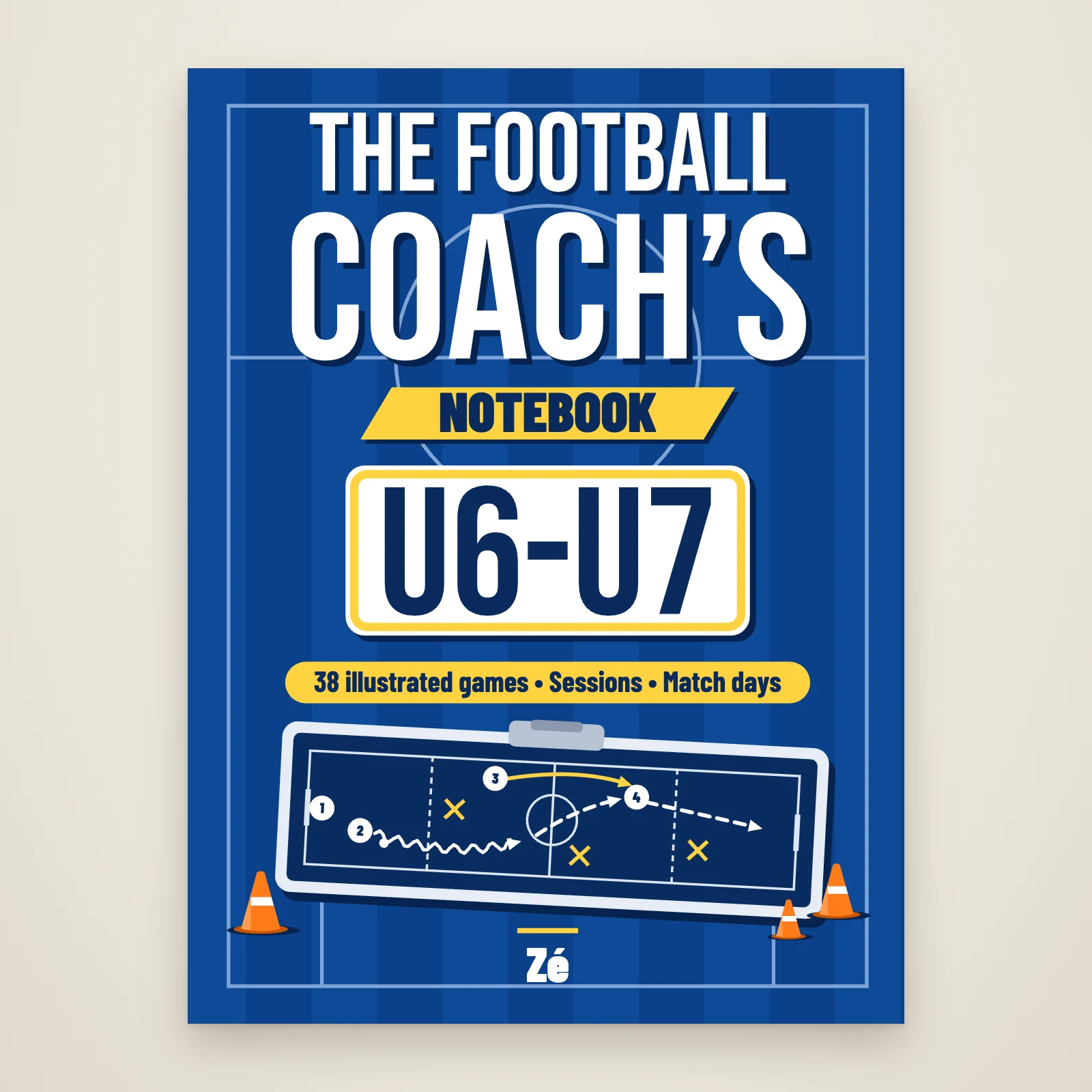
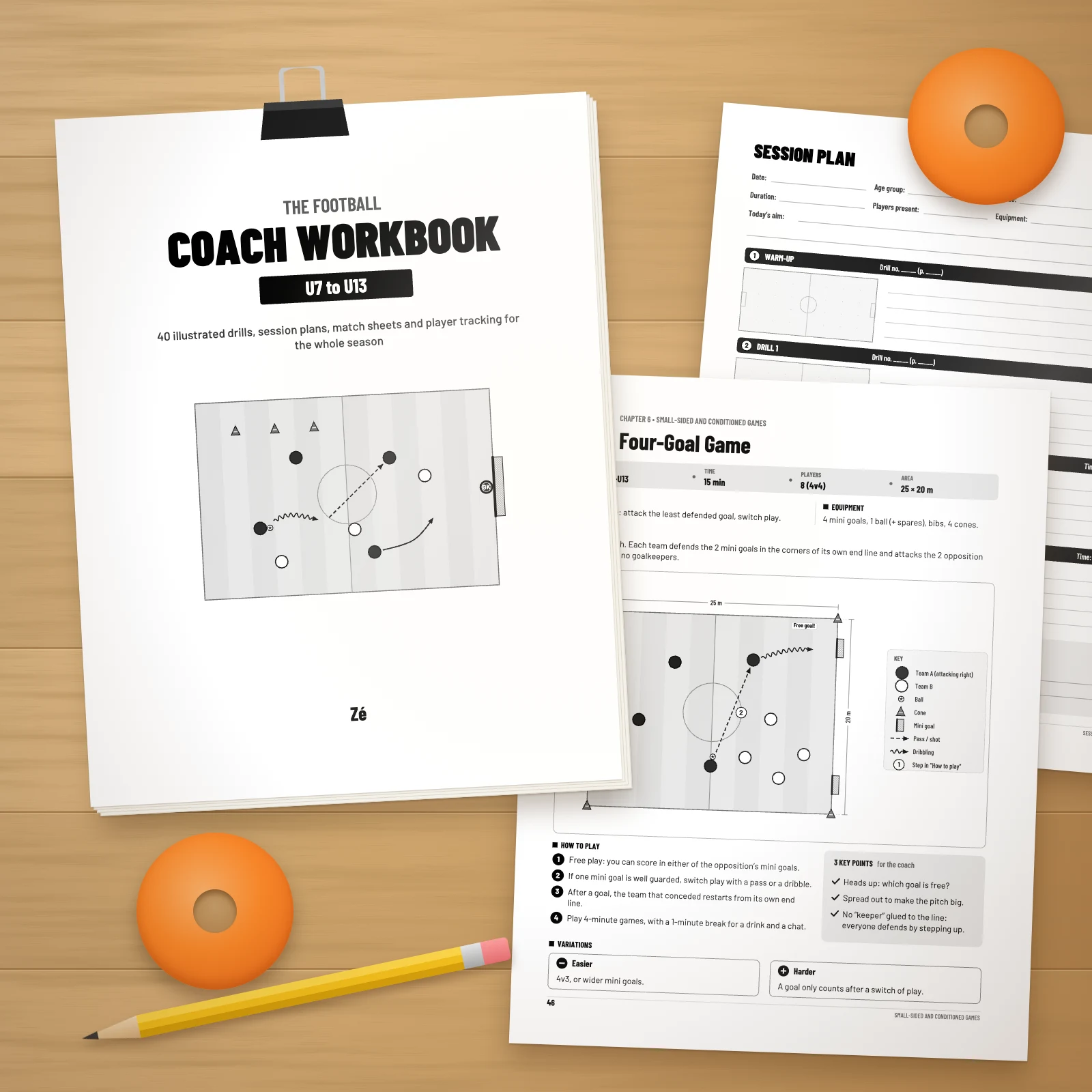
Our U6-U7 coach's notebook follows this outline: 38 games told as stories in 7 chapters, 26 session plans to fill in, 16 match-day sheets and a season review. If you coach several age groups, the U7 to U13 workbook has 40 drills marked by age group: 12 for U7-U9 and 7 that suit both younger and older groups. Both are in our football coaching workbooks, as printable PDFs.
Plan your U7 season
Frequently asked questions
How long should a U7 football session be?
About an hour on the pitch. If your club gives you 45 minutes, keep the outline and shorten each game rather than dropping the mini-match: it is the part the children look forward to.
How many children per coach?
Follow your club's and county FA's guidance on adult supervision. In practice, two adults for a group of 8 to 12 means one can run the games while the other deals with laces, plasters and toilet trips.
What ball size do U7s use?
A size 3, the ball used in England Football's 3v3 format for under-7s.
Do U7s play in goal?
Not in 3v3 matches, which have no goalkeepers. In training, give everyone a turn with keeper games so the children who enjoy it can practise.