Word Search Books for Seniors: How to Choose One
Zé · Published 21 October 2026
Good word search books for seniors share four things: big bold letters in squares of at least 1 cm, one grid per page, words that never run backwards and the answers at the back. After that, the right book depends on the person: the themes they enjoy, how quickly they finish a puzzle, and whether they like a bound book or loose pages on a clipboard.
We used these criteria for our own large print word search books. Here is how to check each one before you buy or print, and the traps that are common in newsagent puzzle books.
6 things that make a grid easy to read
1. The size of the letters
For ordinary text, “large print” usually means 16 point or more. A word search needs more than that, because you are not reading whole words: you are hunting for single letters packed close together. Look for bold capitals of at least 20 point. Ours use bold 23 pt capitals. If a listing gives no figure and shows no inside page, be careful: “large” or “jumbo” on a cover often describes the size of the book, not of the letters.
2. The size of the squares, and of the grid
The same page can hold very different grids. A 13 × 13 grid across about 15.6 cm of paper gives squares of 1.2 cm (about ½ in). Squeeze a 20 × 20 grid into the same width and each square shrinks to under 8 mm, so the letters have to shrink too. For an easy read, look for grids of 13 × 13 or 15 × 15 at most.
3. Black on white
Crisp black letters on white paper, with thin grid lines or none. Tinted backgrounds, grey letters, pictures behind the grid and fancy fonts all make the letters harder to pick out.
4. The word list
It should sit just below the grid, in large print too, with a box to tick next to each word. Around 15 words per puzzle is a comfortable amount: enough for a good half-hour, not so many that the grid becomes a wall of answers.
5. One puzzle per page
Many puzzle books fit two or four grids on a page to raise the puzzle count on the cover. The result is small grids and small lists. A full-page grid with its list underneath is easier to follow without losing your place.
6. Answers that are easy to find
Solutions belong at the back of the book, not on the back of the puzzle, with the words circled. Best of all is a line under each puzzle giving the page of its solution, so nobody has to leaf through thirty pages to check one word.
Easy or hard: choosing the level
The level of a word search comes from four settings, best looked at together:
- The grid: 10 × 10 or 13 × 13 to begin with. Beyond 15 × 15, searching takes a long time.
- The number of words: 12 to 15 for a 13 × 13 grid. Twenty or more fill the grid and make it denser.
- The directions: an easy puzzle uses three or four directions and never backwards (left to right, downwards, diagonally). A hard one uses all eight.
- Multi-word answers: in a well-made easy book, they are joined up and the rules say so (CREAM TEA becomes CREAMTEA). Puzzles with a hidden message in the leftover letters add a step.
For a first book, start easy. If the puzzles are finished too quickly, move on to bigger grids or backwards words. The other way round tends to put people off: a grid abandoned halfway leaves a bad memory of the game.
Themes that mean something to them
A familiar theme makes the search more enjoyable: you guess the words before you read them, and the puzzle turns into a conversation. Everyday and nostalgic themes work well: the seaside, the corner shop, Sunday lunch, the Swinging Sixties, Bonfire Night, a trip to the pictures, places they know. Avoid lists full of brand names, modern slang or technical words.
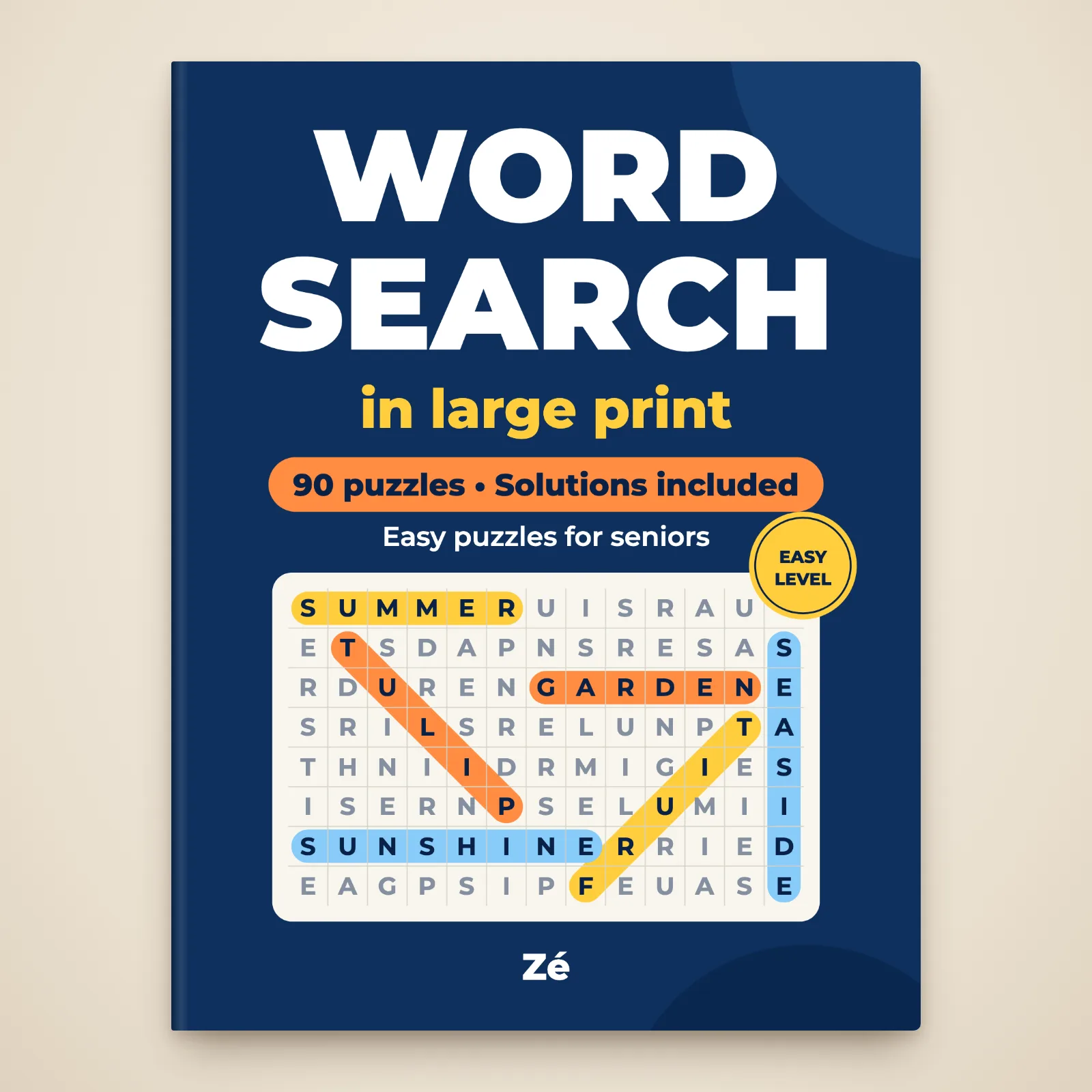
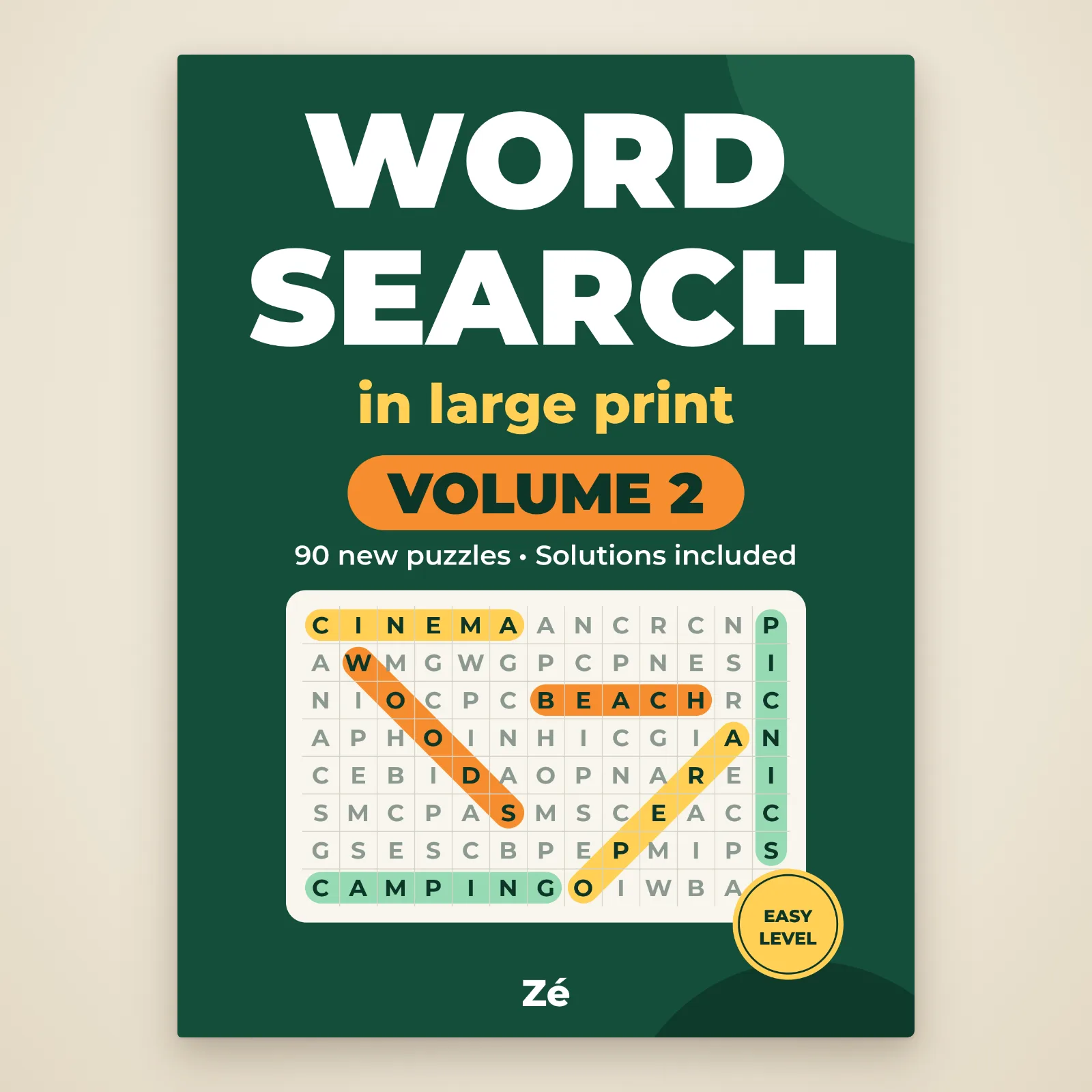
Look at the contents page when you can. In our Large Print Word Search, volume 1 you will find At the Bakery, Afternoon Tea, At the Dance Hall and Bonnie Scotland; in volume 2, In Cornwall, The Corner Shop, Coffee Morning, At the Chippy and World Cities.
Book, printable PDF or free grids?
- Free grids online: handy to try the game. Quality varies a lot, so check the letter size and print one before printing twenty.
- A paperback: ready to use and nice to give. A finished puzzle stays finished, and some books won't lie flat; spiral-bound ones do.
- A printable PDF: you print one puzzle at a time, reprint a favourite to do it again or for someone else at home, and choose the paper. Finished pages can go into a ring binder, or a whole set can be spiral-bound at a print shop.
Our three books are PDFs with the same layout: 13 × 13 grids with bold 23 pt capitals, 15 words per puzzle, never backwards, solutions at the back, two per page. Volumes 1 and 2 have 90 puzzles each, all different, and the Christmas book has 64. They print in black and white on A4 or US Letter, and the licence covers personal and family use, so not copies for every resident of a care home. All three are in our large print word search books section.
Comfort around the puzzle
- Light: a lamp angled onto the page, from the side opposite the writing hand, rather than the ceiling light. Avoid sitting with a bright window behind the page.
- Pencil: a soft pencil (B or 2B) marks without pressing hard and rubs out. A yellow highlighter is an alternative to circling.
- Something firm to lean on: a clipboard or a tray for the armchair, with the page lying flat rather than on the knees.
- Glasses: an up-to-date pair for reading distance. If their eyesight has changed, an eye test with an optician is the first step.
Word search, crossword or codeword?
The three puzzles open differently. A word search gives you the words: no clues to crack, just looking, which makes it the easiest to start and the one a grandchild can share. A crossword asks for answers from clues, quick or cryptic, so it leans on vocabulary and general knowledge. A codeword replaces every letter with a number and asks you to work out the code, a puzzle of logic as much as words. Many people enjoy all three; for someone who finds clues frustrating, the word search is the gentle option.
A Christmas word search as a gift
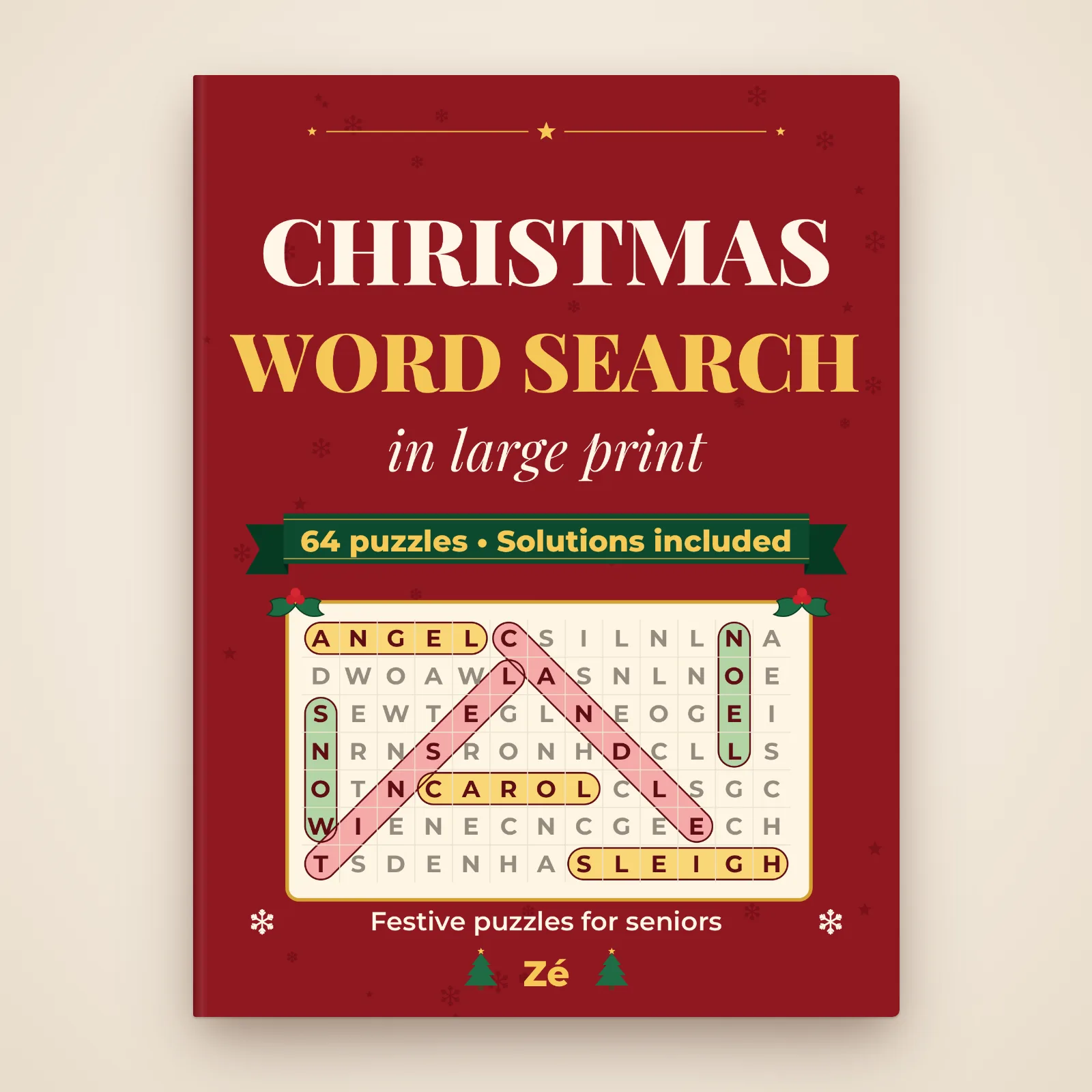
Our large print Christmas word search follows the same layout with 64 festive puzzles that run from Advent to Pancake Day: Stir-up Sunday, Mince Pies, Carols and Choirs, Panto Time, the Boxing Day Buffet, New Year's Eve and Twelfth Night. Words run left to right, downwards or diagonally, down or up, never backwards. Print it, tie it with a ribbon or have it spiral-bound, and give it with a good pencil and an eraser: a stocking filler for a grandparent that lasts well into the new year. For more ideas for the season, see our Christmas activities for the elderly.
Our large print word search books
Frequently asked questions
What size print is large print for a word search?
For ordinary text, large print usually starts at about 16 point. For a word search, aim higher: bold capitals of 20 point or more, in squares of at least 1 cm. Our books use bold 23 pt capitals in squares of about 1.2 cm.
Are word searches good for seniors?
They are an easy puzzle to pick up: the words are given, the rules fit in two lines and a puzzle can be done alone or with a visitor. Choose large print, one grid per page and no backwards words, and the pleasure is in the hunt.
Where can I buy large print word search books in the UK?
Bookshops, newsagents and online shops all sell them; check the letter size and look at an inside page before buying. Or choose a printable PDF, such as ours, and print the puzzles at home on A4.
Which of your word search books should they start with?
Volume 1 for everyday themes, then volume 2, whose 90 puzzles are all new. From December, the Christmas book's 64 puzzles take them from Advent to Pancake Day.