Word Search Tips and Tricks: How to Find Words Faster
Zé · Published 21 October 2026
The quickest way to solve a word search is to stop reading the grid letter by letter. Pick out an unusual letter or a double letter from the word you want, find it in the grid, then check only the neighbouring squares in the directions the puzzle allows. Add a ruler to sweep row by row, and most words turn up in a minute or two.
Below: how a word search works, which directions the words can run, seven practical tips, how to explain the game to a beginner and when to look at the answers.
How a word search works
A word search is a square grid of letters with a list of words underneath, usually on one theme. Each word is hidden in a straight line, with its letters next to each other. You circle each word you find and tick it off the list. A few rules are common to most puzzles:
- One letter can belong to two words where they cross.
- Words with several parts are joined up: ice cream becomes ICECREAM, with no space or hyphen.
- In a well-made puzzle, each word appears in only one place. If you find a word twice, one of them is probably a near miss: check the spelling.
- The leftover letters mean nothing. Some puzzles hide a message in them, but they say so in the instructions.
Which directions can the words run?
A word can run in up to eight directions: left to right, right to left, downwards, upwards and along four diagonals. Harder puzzles use all eight. Easier ones leave out the backwards directions, which makes a big difference: you only ever read the way you normally read.
In our large print word search books (volumes 1 and 2 and the Christmas edition), words run in four directions only: left to right, downwards, and diagonally from left to right, going down or going up. Nothing is backwards. Each book opens with a How to Play page and a small example grid: in volume 1, APPLE runs across, KIWI down, LEMON on a downward diagonal and PEAR on an upward one. Always read the instructions of a new puzzle book first; it changes where you look.
7 tips to find words faster
- Hunt the rare letter. Look for the least common letter in the word, not the first one. In a puzzle about the seaside, find the Z of BREEZE or the K of ROCKPOOL rather than the E or the R, which are everywhere.
- Spot double letters. The LL of HOLLY, the EE of REINDEER, the OO of BALLOON stand out because pairs are rarer than single letters.
- Check only the allowed neighbours. Once you have the starting letter, look at the squares around it for the second letter. In a puzzle with no backwards words, there are only four to check: to the right, below, down-right and up-right.
- Sweep with a ruler or a card. Slide a ruler or a folded piece of card down the page, one row at a time, and read along the row looking for the start of the word. Then do the same down the columns.
- Do the long words first. They have fewer possible places, and once they are circled, the rest of the grid is easier to scan.
- Look for a chunk, not a letter. For long words, search for a distinctive pair or trio: the WH of WHEELBARROW, the CK of CRACKER, the QU of QUEEN.
- Change how you look. Good light on the page, a pencil to point with, and a short break when you are stuck. Words you could not see often jump out when you come back.
Explaining word searches to a beginner
A word search is one of the few puzzles a grandparent and a grandchild of seven or eight can do side by side, each at their own level. To introduce it to someone who has never tried:
- Start with an easy grid: big letters, no backwards words, a theme the beginner knows well.
- Find the first word together. Read it out, look for its first letter with a finger, then follow the line.
- Explain the directions with the finger, not with words: “It can go this way, this way or slanting, but never backwards.”
- Take turns. One person picks a word from the list and reads it aloud, the other hunts. Swap after each word.
- Use two coloured pencils, one per player, so everyone can see who found what at the end.
A child who is still learning to read can read the words aloud while the adult hunts. And when an older person's eyes get tired, the child can hold the ruler.
When to look at the answers
Peeking is not cheating, it is how you finish the puzzle. A sensible rule is to look only once you have swept every row and every column for the word's first letter. Before you do, check the spelling in the list: a word made of two parts (WATERINGCAN) is easy to miss if you are looking for two words.
In our books, the page of the solution is printed at the bottom of each puzzle, and the solutions are grouped at the back, two per page, with every word circled. To check just one word, cover the rest of the solution grid with a sheet of paper.
Easy puzzles in large print
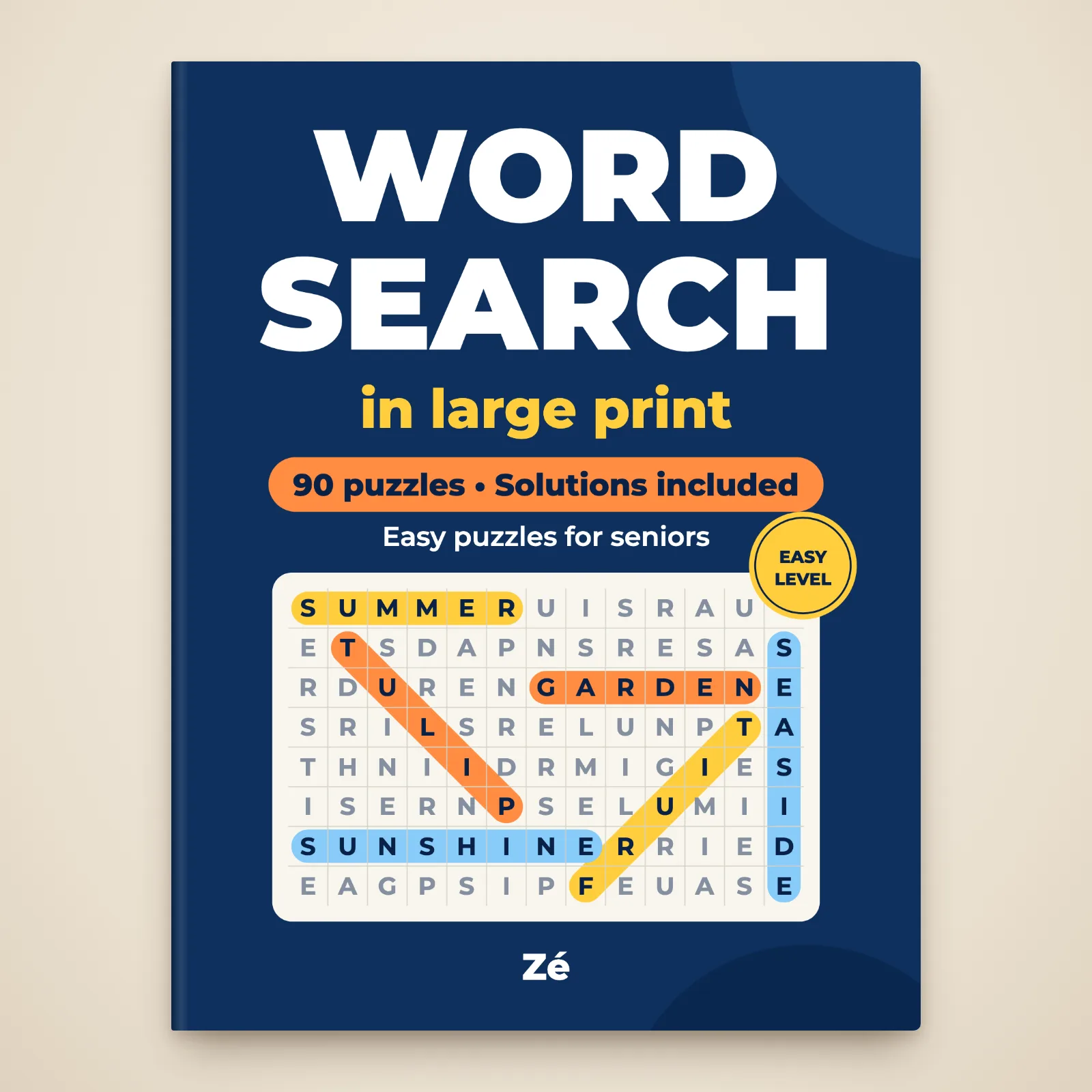
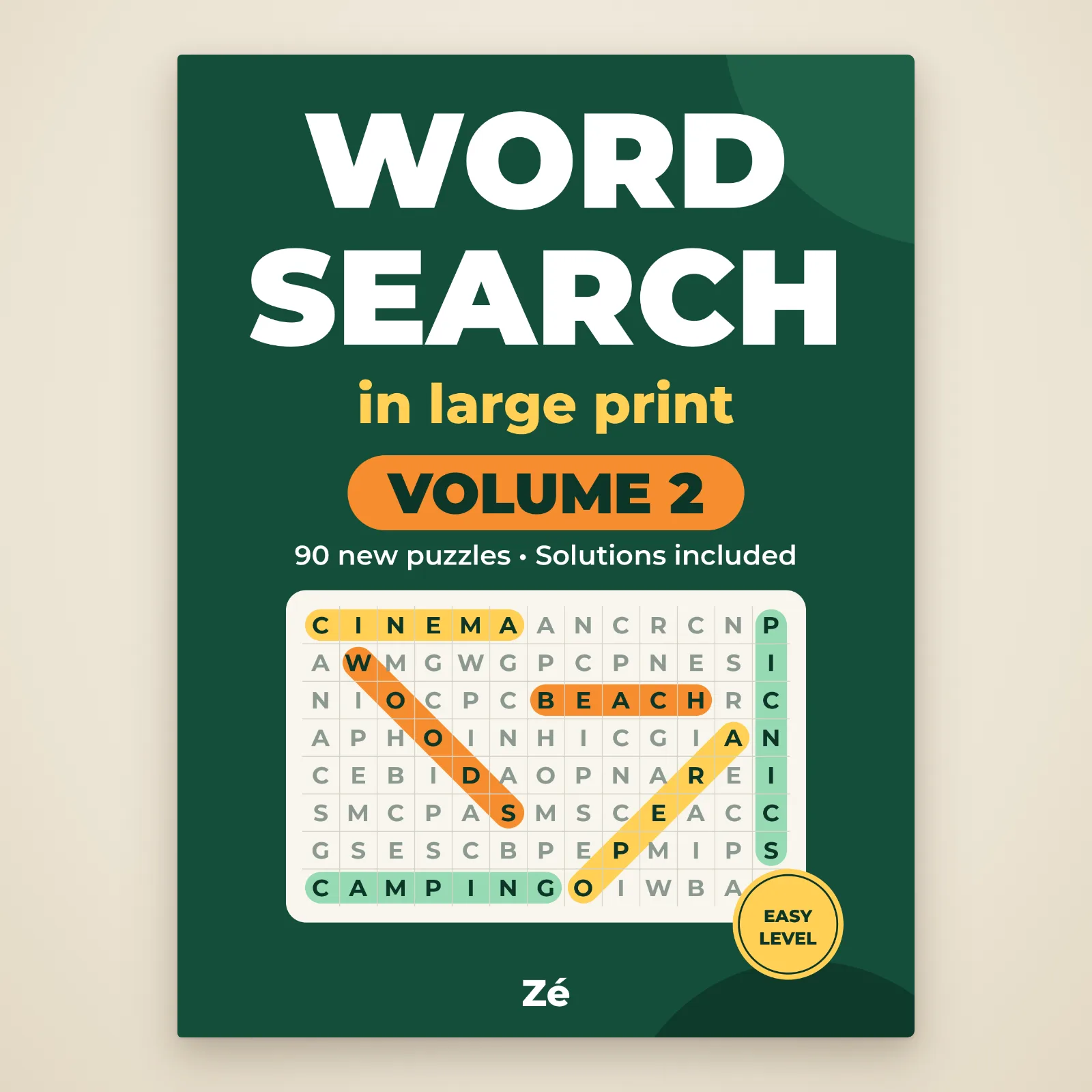
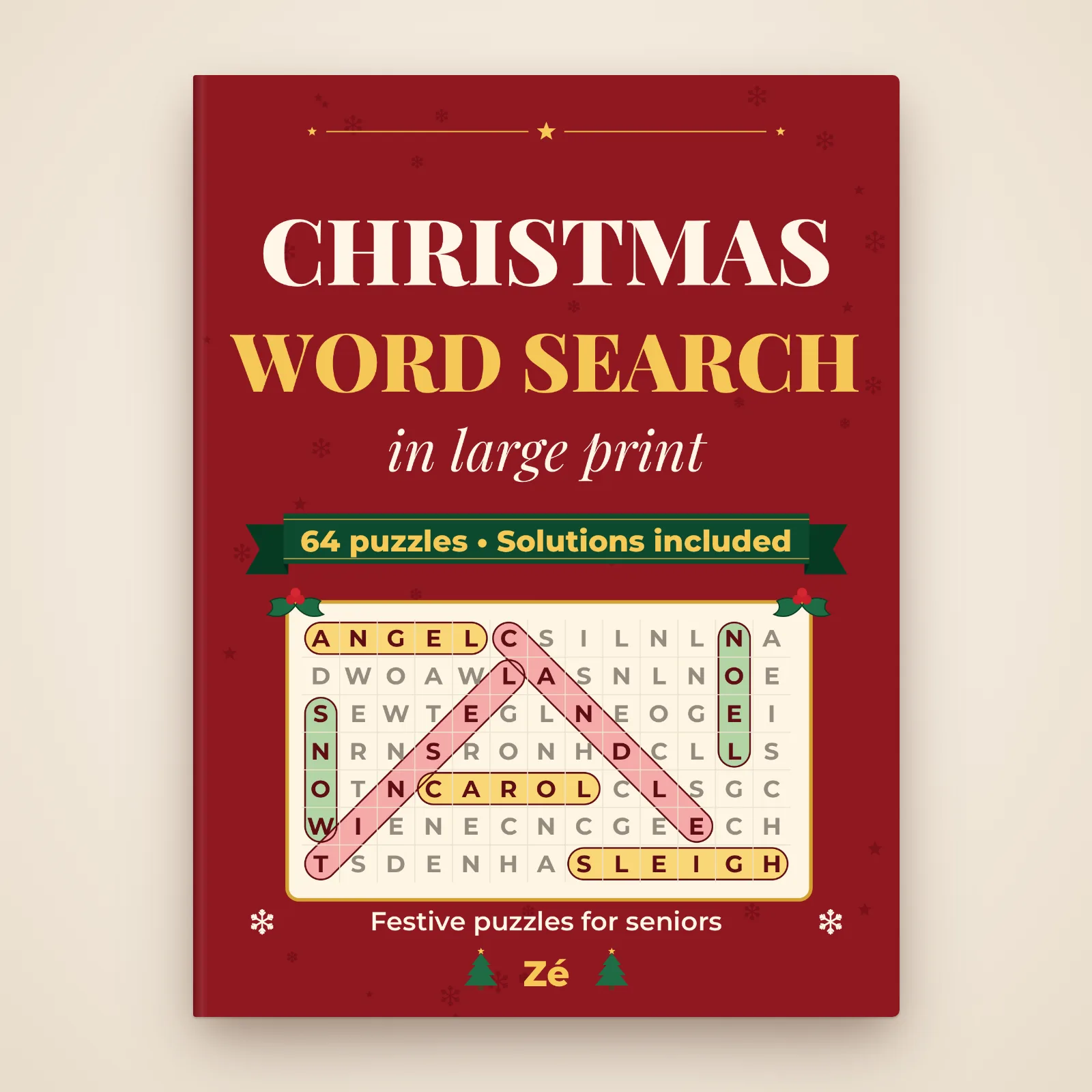
If the letters in magazine puzzles are too small, try Large Print Word Search, volume 1: 90 easy puzzles with one 13 × 13 grid per page, squares of about 1.2 cm (1/2 inch), big bold capitals and 15 words per puzzle, all in the four directions described above. The themes are mostly British (Afternoon Tea, Puddings, Cities of Britain), with a few for American readers such as American States and The Wild West. Finished it? Volume 2 brings 90 new puzzles on fresh themes (In Cornwall, The Swinging Sixties, Coffee Morning), and the large-print Christmas word search has 64 festive ones from Advent to Pancake Day, in the same four directions: there too, a diagonal word can run upwards. All three are black-and-white PDFs printed at home on A4 or US Letter, so you can print a favourite puzzle again, and they sit in our large print word search section. Choosing for someone else? Our guide to word search books for seniors lists what to check. Want to make your own? Here is how to make a word search step by step.
Easy puzzles in large print
Frequently asked questions
Can words in a word search go backwards?
In many puzzles, yes: words can run in all eight directions. Easy puzzles often leave out the backwards directions. In our large print books, words only run left to right, downwards or diagonally from left to right, never backwards.
What is the fastest way to solve a word search?
Look for the rarest letter or a double letter in the word, find it in the grid, then check only the neighbouring squares in the allowed directions. Do the long words first and sweep the grid row by row with a ruler.
Are there easy word searches for seniors?
Yes. Look for large print (squares of at least 1 cm), one grid per page, no backwards words and familiar themes. Ours has squares of about 1.2 cm, bold capitals and 15 words per puzzle.
What should I do if I can't find the last word?
Check its spelling in the list first, especially if it is made of two parts joined together. Then sweep every row and column for its first letter. If it still won't show itself, look it up in the solutions, covering the rest of the grid.